
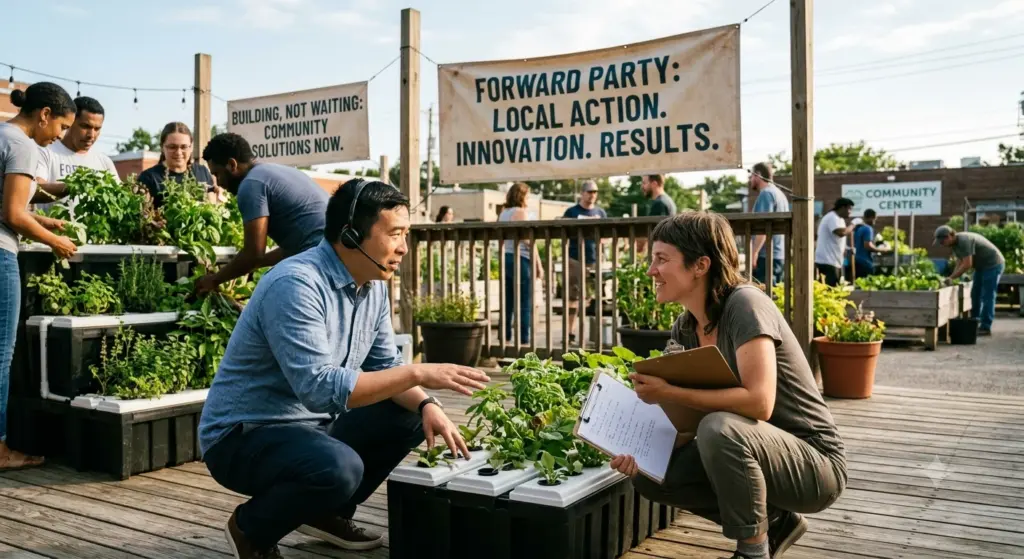
I keep seeing the same question pop up in tech and politics circles lately: why Andrew Yang is building instead of waiting for Washington. It’s a fair thing to wonder about. The guy ran for president on one big idea, lost, and instead of fading into the usual ex-candidate circuit of think pieces and cable hits, he’s out there launching startups. That’s not the typical playbook. So what happened? Also Read Why Are Companies Investing Billions in AI Infrastructure?
Table of Contents
Back in 2017, This Sounded Crazy
When Yang first started talking about automation wiping out American jobs, most people treated it like a gimmick. A tech guy running for president with a $1,000-a-month check for every adult? Reporters loved the novelty angle more than the substance. Nobody in Washington was having a serious conversation about AI and labor markets in 2017 or 2018 — Yang basically had to shout into a void.
Things look different now. Dario Amodei over at Anthropic has said publicly that AI could eliminate a huge chunk of jobs within five to ten years. Sam Altman’s been talking about a national wealth fund, which is basically UBI with a rebrand. Even Bernie Sanders, who used to think Yang’s dividend was too small a fix, has put forward legislation to study direct cash payments. Yang’s own reaction to all this, more or less, has been: of course this is happening, I said it would.
And that’s really where the answer to why Andrew Yang is building instead of waiting for Washington starts. He watched his fringe idea become the consensus view among some of the most powerful people in tech and politics, and Congress still hasn’t done anything meaningful with it.
He Went Back to Building Things
After the 2020 campaign fizzled out, Yang didn’t just retreat to punditry. He started the Forward Party, aimed at things like ranked-choice voting and breaking up the two-party lock on elections. That’s the political side. But he’s also gotten his hands dirty with actual companies.
Take Noble Mobile, his newest project. The pitch is almost funny in how simple it is — the company pays you for using your phone less. It’s a direct shot at the attention economy that most of Silicon Valley has built its business model around. It isn’t UBI exactly, but you can feel the same instinct underneath it: put money in people’s pockets now, don’t wait around for a bill that might die in committee.
This is basically the whole pattern with him. Build something small and real while the bigger fix stalls in Congress. It’s a big part of why Andrew Yang is building instead of waiting for Washington to get its act together — he doesn’t seem to think waiting is a strategy at all anymore. Also Read How to Connect Bluetooth Device to any TV? Complete Guide
Proving It Beats Arguing About It
What I find more interesting than the startups themselves is the underlying theory. Yang isn’t just impatient with government, he’s arguing you can actually demonstrate that a policy works before a single vote gets cast on it. Basic income pilots in various cities have given him something better than applause lines — actual numbers. His logic seems to be: build it, run it, show people the results, and let the political will show up after the fact instead of before.
That’s a pretty different bet than running for office again and hoping voters are more receptive this time around. And honestly, it might explain why Andrew Yang is building instead of waiting for Washington rather than mounting another campaign built on the same warnings he’s been repeating for years.
He’s Not the Only One Thinking This Way
There’s a wider mood shift happening among tech-adjacent leaders, a growing sense that government just can’t move at the speed AI is forcing on everyone else. Whether that’s fair to lawmakers, who are dealing with a genuinely hard problem, is its own argument. But it’s clearly shaping how people like Yang decide to spend their time and money.
Not everyone buys the underlying economics, of course. Critics still argue UBI costs too much and might discourage people from working. Yang’s response hasn’t really changed over the years — he thinks the cost of doing nothing, more inequality, more social strain, more people getting displaced with nothing to catch them, is a lot higher than the cost of trying something. Also Read How to Recover Deleted Photos on iphone and Android?
So, Where Does That Leave Things
Why Andrew Yang is building instead of waiting for Washington, in the end, comes down to one blunt lesson from his campaign: waiting for the system to move first didn’t work. So he flipped the order. Build the proof first, gather the results, let the policy argument follow the evidence instead of leading it.
Whether this actually reshapes national policy someday, or just ends up as an interesting footnote in the long history of the UBI debate, isn’t clear yet. But it’s a pretty honest answer to the question a lot of people keep asking about him.