

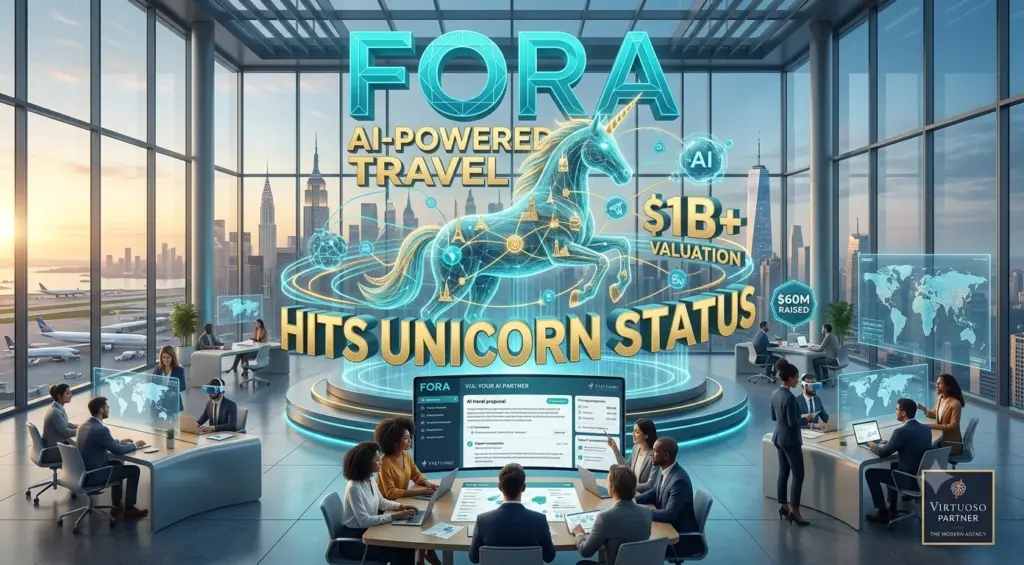
There’s a weird little irony playing out in tech right now, and it’s kind of hard to ignore. Everyone’s spent the last couple years convinced AI is coming for entire job categories, and then this week a company built almost entirely around actual human travel agents turns into a billion-dollar business. Fora Hits Unicorn Status, Raises 60M Dollars in a new Series D, and once you dig past the headline number, the actual story is a lot stranger and more interesting than a typical funding announcement. Also Read How the First AI Run Ransomware Attack Still Needed a Human
Table of Contents
The Basics of the Deal
Here’s what actually happened. Fora, based out of New York, runs a platform that helps regular people become travel agents, and it just closed a $60 million Series D led by Forerunner and Tactile Ventures. That puts the company at a $1 billion valuation, which is the unicorn part everyone’s talking about. A handful of earlier backers came back for the round too Thrive Capital, Insight Partners, Heartcore Capital and a few new names jumped in, including PLUS Capital, along with Amy Schumer, who’s apparently part of what Fora calls its artist and athlete investor collective. Not something you see in every funding announcement.
With this raise, Fora has now pulled in $138.5 million total since it was founded back in 2021. Not bad for a company built on the idea that regular people, not big corporate agencies, could run their own travel businesses. That’s really the core of why Fora Hits Unicorn Status, Raises 60M Dollars feels like such a notable moment right now it’s not the typical AI story where software replaces workers. It’s closer to the opposite.
What Fora Actually Does
The platform works two ways. On one side, it gives anyone the tools to become a working travel agent — client communication, itinerary planning, the whole back-office setup you’d need without having to build it yourself. On the other side, travelers use Fora to find an advisor and plan trips, whether that’s a honeymoon in Costa Rica or a family trip to Thailand.
What makes the growth numbers wild is the pace. Fora took three years to hit its first billion dollars in lifetime bookings. Then eight months to hit the second billion. And the third billion came in just five months. That kind of acceleration is a big part of the story here, and it’s a lot of the reason investors are excited enough that Fora Hits Unicorn Status, Raises 60M Dollars is getting so much attention across the travel and tech press this week.

Where the AI Actually Fits In
Here’s the part that makes this different from a typical AI unicorn story. Fora isn’t trying to replace its advisors with software. Instead, a chunk of the new funding is going toward Via, the company’s AI assistant, which handles the tedious parts of the job research, drafting itineraries, that kind of administrative grind that eats up an agent’s day without actually building any client relationships.
The idea is that human agents spend more time on the parts that actually matter, the relationship building and trip customization, while AI quietly handles the busywork behind the scenes. It’s a bet that AI makes people more productive rather than obsolete, and it’s a bet that seems to be paying off so far, at least based on the numbers. Fora now has more than 15,000 active advisors working across 180 countries, and 97% of them are new to the travel industry entirely former lawyers, doctors, full-time parents, retirees, people who found a side hustle or a full career change through the platform. Also Read How to check phone is original or fake?
Why This Is Turning Heads in the Travel Industry
There’s a bigger context here too. LinkedIn ranked travel advisor as the fifth-fastest-growing job in the U.S. in 2025, which on its own is a little surprising given how many people assumed the internet, and later AI, would kill off travel agents entirely. Fora’s growth seems to be riding that same wave rather than fighting against it.
Tactile Ventures’ Brian O’Malley, one of the investors behind this round, has said Fora is growing faster than any other company in the AI travel space, largely because it blends automation with actual human accountability rather than picking one over the other. That’s basically the pitch driving why Fora Hits Unicorn Status, Raises 60M Dollars is being treated as more than just another funding headline it’s being read as a signal about how AI and human labor might actually coexist in an industry a lot of people had already written off.
What Comes Next
Not everyone’s convinced this is a permanent arrangement, though. Some of the skepticism floating around points out that Fora’s whole model depends on humans staying relevant in travel planning, and that companies like Trip.com and Expedia are already building fully autonomous AI agents that can plan and book an entire trip without a person involved at any point. If that kind of tech gets good enough, Fora’s army of human advisors could end up competing directly with software instead of just with other agencies. Also Read How the First AI Run Ransomware Attack Still Needed a Human
For now, though, the momentum is clearly on Fora’s side. The booking numbers keep accelerating, the advisor base keeps growing, and the investor list keeps getting more interesting. Whether this augment-don’t-replace approach holds up over the next few years is anyone’s guess, but right now, Fora Hits Unicorn Status, Raises 60M Dollars stands as one of the more unusual success stories in an industry everyone assumed AI was going to hollow out rather than help rebuild.