
For years, foldable smartphones have lingered on the edges of mainstream tech adoption impressive in demonstrations, but perpetually categorized as niche, expensive, and fragile. That narrative, however, is on the verge of a major shift. New research from multiple industry analysts confirms and also technewsdaily what many have long speculated: Apple could expand the foldable market from an enthusiast’s playground into a global mainstream category. With the highly anticipated iPhone Fold expected in late 2026, the data is increasingly hard to ignore.

Table of Contents
The Foldable Market Today: Promise Held Back by Barriers
Before understanding Apple’s potential impact, it’s important to appreciate where the foldable market currently stands. According to IDC’s Worldwide Quarterly Mobile Phone Tracker, global foldable smartphone shipments grew 10% year-on-year in 2025, reaching approximately 20.6 million units. While that sounds impressive, it represents just about 1.6% of the total smartphone market a strikingly small slice for a category that has existed for several years. Also Read: How to Speed Up a Slow Android Phone in 2026
TrendForce’s analysis points to the persistent obstacles standing in the way: screen crease visibility, concerns about long-term durability, and premium price tags that often run 1.5 times the cost of a conventional flagship. For consumers without strong brand loyalty to early adopters like Samsung or Huawei, the incentive to switch remains limited. Foldables have largely remained what TrendForce describes as “high-end experimental devices” — admired but not widely adopted.
Samsung currently leads the segment but is losing ground. Its global market share is expected to drop from 45.2% in 2024 to 35.4% in 2025, as Chinese brands like Huawei, Xiaomi, OPPO, and vivo aggressively expand their foldable portfolios. The competitive landscape is diversifying but it still lacks the catalyst needed to break foldables into the mass market. That catalyst, analysts broadly agree, is Apple.
Why Apple Could Expand the Foldable Market Like No One Else
The case for Apple as a transformative force in foldables is rooted in consumer behavior data and brand dynamics that go far beyond hardware specs.
1. Massive Installed Base and Brand Loyalty
Apple commands an enormous base of loyal iPhone users, particularly in North America and Western Europe the two regions with the highest willingness to pay for premium devices. Counterpoint Research projects that Apple could capture 46% of North America’s foldable market in its debut year alone. That’s not a gradual takeover that’s a category reshaping overnight.
For Android users who have been evaluating book-style foldables from Samsung, Motorola, or Google, the arrival of an Apple foldable introduces a compelling new alternative. As Counterpoint Principal Analyst Gerrit Schneemann noted, Apple’s entry “will immediately reshape the foldable competitive landscape in North America,” placing considerable competitive pressure on existing players.
2. Software That’s Already Ready
One of the biggest hurdles foldable makers face isn’t the hardware it’s the software. Optimizing apps and interfaces for a dynamic screen that can shift between phone and tablet mode is genuinely difficult. Apple, uniquely, already has years of experience with iPadOS and large-screen software optimization. Counterpoint notes that Apple “appears particularly well-positioned given its long-standing experience with iPadOS,” giving it a head start that Android OEMs have spent years trying to replicate. Also Read: How to Transfer Data from old Iphone to New Iphone? Complete Guide
This means the iPhone Fold won’t just be a new piece of hardware it will launch with an ecosystem of apps and interfaces already primed for the larger, flexible display.
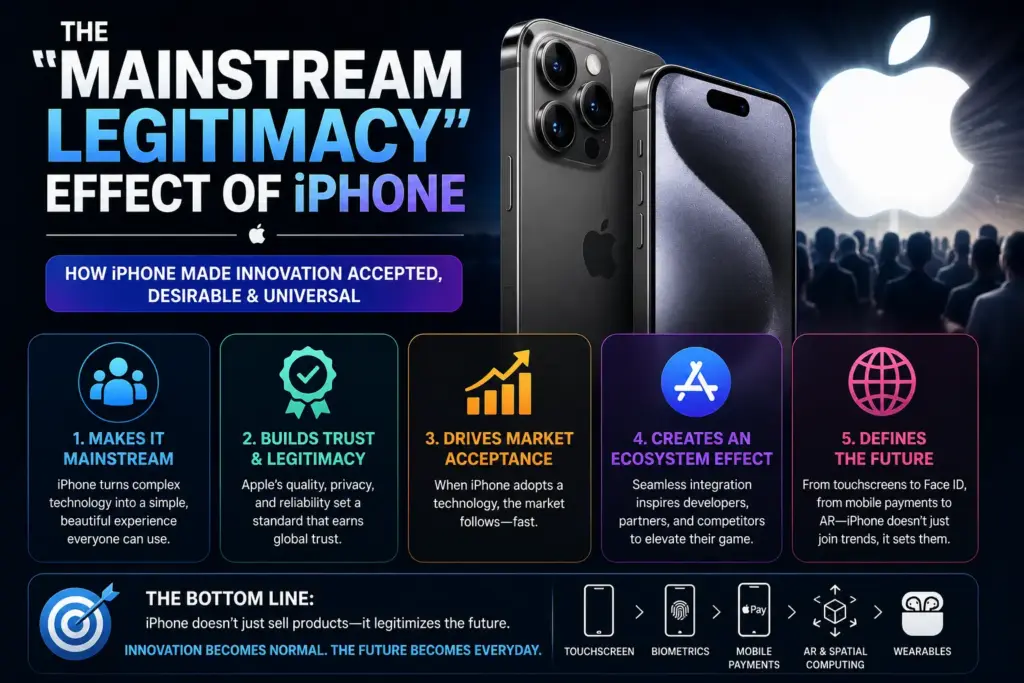
3. The “Mainstream Legitimacy” Effect
There’s a well-documented pattern in consumer technology: when Apple enters a category, it doesn’t just compete — it validates. We saw it with smartwatches when the Apple Watch redefined what a wearable could be. We saw it with wireless earbuds when AirPods normalized truly wireless audio. Research from SmartTech, conducted in May 2026 across 531 consumers in diverse U.S. geographic regions, found strong directional evidence that Apple’s entry into the foldable space is generating genuine consumer interest far beyond typical early-adopter demographics. TrendForce puts it plainly: Apple’s 2026 debut could be the turning point that drives foldables into the mainstream.
What the Numbers Say: A Market About to Accelerate
The forecasts are remarkably aligned across multiple research firms, which lends unusual confidence to the outlook:
- IDC forecasts 30% year-on-year growth in foldable shipments in 2026 up from just 6% growth in its prior forecast, with Apple’s entry cited as the primary driver.
- Counterpoint Research projects 20% global growth in foldable shipments in 2026, driven by Apple’s entry, continued premiumization, and broader OEM participation.
- Sigmaintell predicts global foldable shipments will reach 24 to 25 million units in 2026, representing a 41%–47% increase over 2025.
- TrendForce expects Apple’s first foldable to lift market penetration from 1.6% in 2025 to over 3% by 2027.
- IDC’s long-range view places foldables at more than 10% of total smartphone market value by 2029, with iOS expected to secure a meaningful share of that figure.
Digitimes further reports that Apple is anticipated to capture more than 22% of global foldable shipments and 34% of foldable revenue in its debut year — a staggering market entry for any product in any category. Also Read: How to Recover Deleted Photos on iphone and Android?
The iPhone Fold: What We Know So Far
While Apple has not officially confirmed the iPhone Fold, a consistent picture has emerged from supply chain leaks and analyst tracking:
- Book-style form factor with an expected 1:1.414 screen ratio optimized explicitly for multitasking and document viewing, not just media consumption.
- 5.5-inch external display, giving it the feel of a regular iPhone in the hand before unfolding.
- Near-creaseless display technology, reportedly achieved through a dual-protection design featuring a metal stress dispersion plate beneath the screen combined with a self-healing coating addressing the single most common complaint about foldable screens.
- Expected launch in September 2026, consistent with Apple’s typical fall product cycle.
The design philosophy signals something important: Apple isn’t building a foldable for the sake of novelty. It’s building one for productivity a device aimed squarely at users who want a powerful working tool, not just a conversation piece.
The Competitive Response: Android OEMs Are Already Preparing
Apple’s anticipated entry is already reshaping how competitors approach 2026. Samsung has launched the Galaxy Z Trifold, introducing a three-panel design to mainstream consumers earlier in the year. Huawei’s foldables, running HarmonyOS Next, are expected to nearly double in shipments. Counterpoint notes that book-style foldables which offer larger displays suited for multitasking — are expanding their market share from 52% in 2025 to 65% in 2026, largely in anticipation of the direction Apple is setting.
Major Android OEMs are, as Counterpoint describes, “accelerating updates to their foldable portfolios to defend their positions in the premium segment.” This is the hallmark of Apple’s market influence: competitors innovate faster not just in response to Apple’s products, but in anticipation of them.
Broader Industry Implications: Why This Matters
The smartphone industry has a problem: people are keeping their phones longer. Replacement cycles have stretched, and incremental updates to traditional flat-screen flagships aren’t compelling enough to drive upgrades. Foldables represent one of the few genuine paradigm shifts available to manufacturers — a new form factor that justifies a premium price and motivates a real upgrade decision. Also Read: How to check phone is original or fake?
IDC’s Nabila Popal framed the stakes clearly: foldables “are becoming critical for an industry that has plateaued and needs meaningful innovation to motivate upgrades and drive value.” With a projected compound annual growth rate (CAGR) of 17% through 2029 compared to less than 1% for the traditional smartphone segment — foldables are where the industry’s growth story is being written.
Apple’s entry doesn’t just add another competitor. It adds the world’s most powerful consumer-technology brand to a category that desperately needs mainstream credibility. If any company can shift consumer perception from “interesting experiment” to “obvious choice,” it’s Apple.
Conclusion: A Category at a Crossroads
The evidence is compelling and converging: Apple could expand the foldable market in ways that no other company is positioned to achieve. The combination of unmatched brand loyalty, a ready-made software ecosystem, and a product philosophy focused on practical productivity rather than gimmickry puts Apple in a uniquely powerful position.
For consumers, this means foldables are about to become a lot more accessible, refined, and mainstream. For competitors, it means the race to differentiate has never been more intense. And for the industry as a whole, Apple’s iPhone Fold could be the inflection point that transforms foldables from a promising niche into one of the defining product categories of the late 2020s.The fold is coming. And with Apple leading the charge, it may finally be here to stay.