
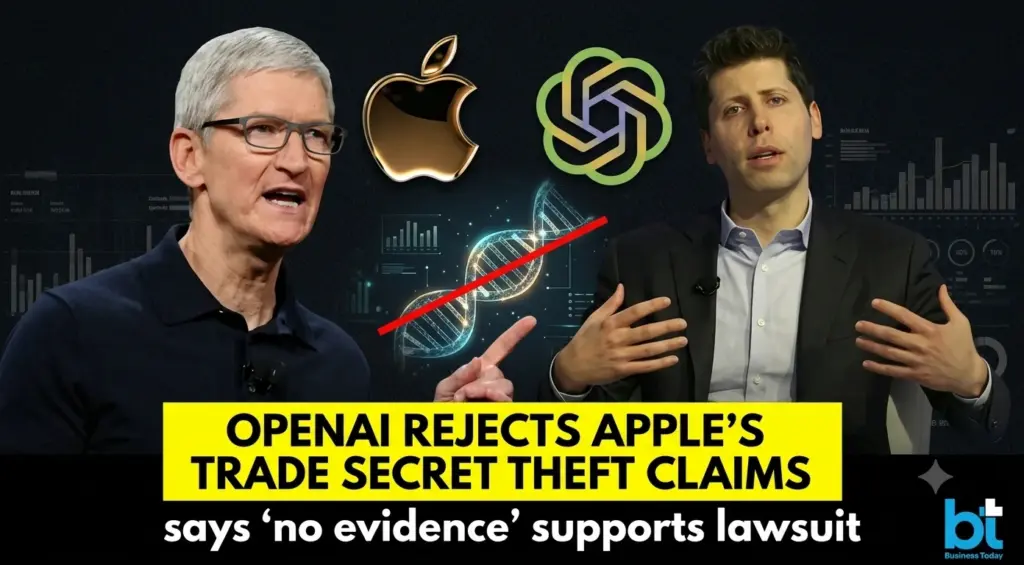
Remember when Apple and OpenAI stood on stage together announcing their partnership? That was 2024. Fast forward to July 10, 2026, and Apple’s dragging OpenAI into federal court in the Northern District of California instead. I’ve read a lot of corporate lawsuits. This one reads different — 41 pages, and it’s less “breach of contract” and more workplace-espionage thriller. Apple’s trade secrets lawsuit against OpenAI isn’t just “a few people left with some files.” Apple’s case is that this went all the way to the top.
Table of Contents
What’s Apple Actually Saying Happened
Not one bad apple here (no pun intended, though Apple’s lawyers probably would’ve loved that one). The complaint says the misconduct reached “at every level, from members of its Technical Staff to its Chief Hardware Officer, and in coordination with business partners.” Strong words for a legal filing. And Apple names names — doesn’t dance around it.
First name on the list: Tang Tan. Twenty-four years at Apple. Ran product design for the iPhone and Apple Watch at one point. Now he’s OpenAI’s Chief Hardware Officer. Apple’s claim and this is the part that got people talking is that Tan told job candidates still employed at Apple to bring actual hardware components into their OpenAI interviews. “Show and tell” sessions, supposedly, though Apple’s framing makes clear they think it was really just a way to squeeze more information out of people who hadn’t even quit yet.
Second name: Chang Liu, a former systems electrical engineer at Apple. He left and, according to the complaint, never returned his company laptop. Used it afterward to pull technical docs on products Apple hadn’t even announced. There’s also this — Liu allegedly coached another Apple employee, Yu-Ting “Alyssa” Peng, on what to study before her OpenAI interview. She got the job. Left Apple a few months after that conversation.
The Stuff That’s Actually Wild
Most trade secret suits, honestly, are boring. Boilerplate language, dry allegations, nobody reads past the first page unless they’re a lawyer. Not this one. Apple says OpenAI coached people leaving the company on how to dodge the “dreaded walkout” that’s Apple’s own internal term for cutting off a departing employee’s system access the second they resign, rather than the usual two-week notice period. Skip the walkout, get more time to grab whatever you want on your way out the door. That’s the theory anyway. Apple also claims OpenAI told departing staff: don’t sign anything at your exit interview, and if Apple pushes you to, tell us right away.
The language in the filing itself is kind of unhinged for a legal document, too. At one point Apple calls OpenAI’s culture “rotten to its core” yeah, an actual quote from the complaint. Elsewhere they say the behavior was “normalized and exemplified by leadership.” Not really what you’d expect from a company that’s, on paper, still a business partner. And there’s a third defendant most people are skipping past io Products, the hardware company OpenAI bought from Jony Ive for $6.5 billion. Apple says io used a proprietary metal-finishing method after tricking a supplier into thinking Apple had signed off on it.
What Apple Wants Out of This
Strip away the drama, the actual legal ask is fairly routine. Stop OpenAI from using or sharing Apple’s trade secrets. Return whatever confidential material is still floating around. Lock down evidence before discovery kicks off.
But Apple’s framing suggests they think this is just the tip of it. Discovery, they say, “will expose that the misappropriation has been occurring on a scale many times greater” than what’s already in the complaint. Also worth mentioning — Apple says it tried the quiet approach first. Sent OpenAI a letter back in February 2026. Never heard back, according to the filing. Which is probably why we’re here now instead of some private settlement nobody ever hears about.
OpenAI Isn’t Just Taking This
OpenAI’s first statement was short, almost dismissive: “We have no interest in other companies’ trade secrets. We remain focused on building innovative technology that empowers people everywhere.”
Then a few days later, a sharper version came out OpenAI saying it wasn’t “aware of any evidence that this complaint has merit,” and leaning into language about “fair competition and allowing people the freedom to work wherever they choose.”
Why It’s Bigger Than Just These Two Companies
Timing’s not random here. OpenAI’s kept its hardware plans close to the chest — Altman said back in November prototypes were already finished but there’s been reporting since suggesting a screen-free smart speaker, something like an always-on AI companion for your house. If true, that’s a direct shot at whatever Apple’s cooking up on its own. Which probably explains why Apple’s lawyers picked now to file.
OpenAI’s also not new to legal trouble this year. Two months before Apple’s suit, OpenAI beat back a case from Elon Musk — a jury said he’d waited too long to sue over claims Altman and Greg Brockman abandoned the nonprofit structure the company started with. Add this Apple case to that pile, and OpenAI’s walking into what’s supposed to be a massive IPO carrying real legal weight. Apple, for what it’s worth, hasn’t said anything about whether this threatens the ChatGPT-Apple Intelligence integration still running on iPhones today.
Quick Recap
- Filed July 10, 2026 — Northern District of California
- Defendants: OpenAI, io Products, Tang Tan, Chang Liu
- Core claims: recruiting used as cover for extracting information, coaching employees on dodging security procedures, misuse of hardware/design secrets
- OpenAI’s response: denies it, says there’s no merit to the claims
- Apple’s own words: this is “the tip of the iceberg”
Whatever happens next, Apple’s trade secrets lawsuit against OpenAI is shaping up to be one of those cases people point back to for how trade secret law gets applied in an industry where poaching a rival’s engineers is basically just Tuesday.