
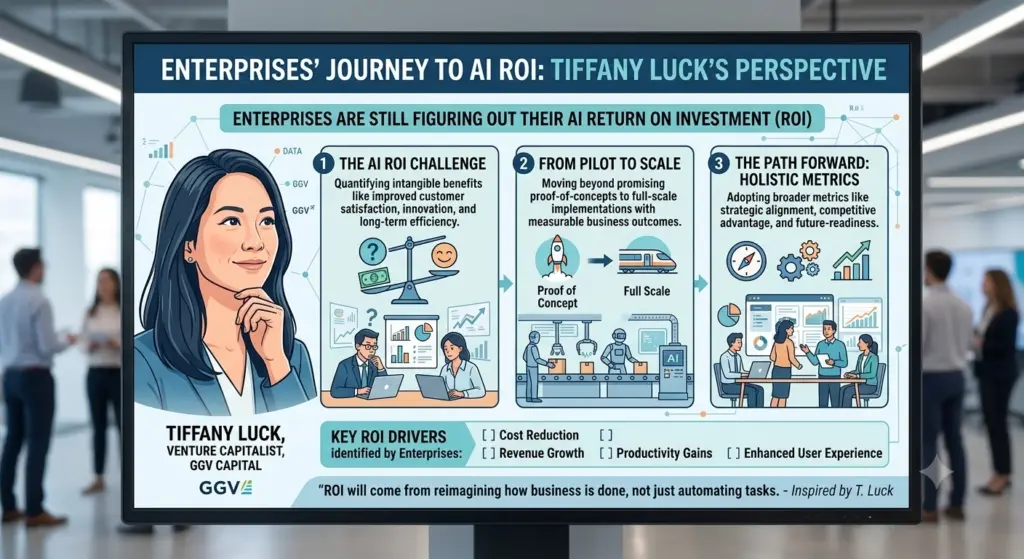
Every few weeks there’s a new venture capitalist saying something insightful about AI spending, and most of it blurs together. But one line has stuck with me: enterprises are still figuring out their AI ROI. That’s NEA partner Tiffany Luck’s framing, and she’s been saying versions of it across a handful of interviews recently — enough that it’s worth actually sitting with why she keeps coming back to it. Also Read How to Integrate AI Recruiting Tools with ATS: A Practical Guide for 2026
Who Is Tiffany Luck, Anyway?
She’s a partner at New Enterprise Associates, which is one of the bigger venture firms out there, and her lane is enterprise tech and AI-native startups. Before AI, though, she was doing the exact same thing with e-commerce convincing skeptical companies that it was worth betting on. Now it’s AI, and she’s especially bullish on what she calls “magic moments” in consumer products, those instances where an AI assistant just gets it right without you having to explain yourself.
She sat down recently on TechCrunch’s Equity podcast to talk AI IPOs, personal agents, and the thing that kept coming up over and over — why enterprises are still figuring out their AI ROI.
Table of Contents
The Real Reason Enterprises Are Still Figuring Out Their AI ROI
Here’s her actual argument, boiled down: most companies don’t have the internal frameworks to track this stuff properly. That’s the crux of it. The old playbook cost per transaction, hours saved per employee, whatever — just doesn’t translate cleanly when the tool you’re evaluating is reshaping how decisions get made across an entire team, not just automating one task.
Her point, more or less in her own words: you can’t look at what you’re spending on API calls and call that the whole picture. You have to actually understand how the tool is changing the work underneath it. That’s a much harder thing to measure, and it’s exactly why enterprises are still figuring out their AI ROI a year-plus into this whole spending cycle.
None of this happened in a vacuum, either. There was a whole phase earlier in 2026 that people started calling “tokenmaxxing” basically, CEOs telling their teams to go all-in on AI usage, don’t worry about the cost, just learn as fast as possible. Uber apparently blew through its entire annual AI budget in a few months doing this. Several companies quietly cut back on Claude seats for parts of their workforce. Meta shut down its internal leaderboard that had been tracking AI usage. That’s the hangover Luck is describing when she says enterprises are still figuring out their AI ROI companies spent first and are only now trying to work out whether it was worth it. Also Read What is Mistral AI? Everything You Should Know About OpenAI’s Competitor
From “Move Fast” to “Prove It”
Luck’s read is that this is a bigger industry shift, not just an Uber or Meta problem. She thinks the tooling for token efficiency and observability is going to end up living at what she calls the “harness or app layer” rather than baked into the models themselves she pointed to a startup called Factory as an example, which just launched a router that automatically picks the cheapest workable model for a given task. Her exact phrase for the vibe shift was that conversations went from “tokenmaxxing” and moving fast to “we need guardrails, how do we control this.”

Which, again, gets right back to the core issue. The reason enterprises are still figuring out their AI ROI is that the measurement tools are only now catching up to how fast everyone adopted the technology in the first place. You can’t audit your way out of a spending problem you didn’t track from day one.
Forward Deployed Engineers, and Betting on More Than One Model
There’s a structural piece to her thesis too. She’s called forward deployed engineers — people who sit embedded inside client companies a kind of “Trojan horse” for adoption, since they prove value from the inside instead of pitching it from the outside. She’s also noticed something interesting: fewer companies are betting everything on one model provider anymore. They’re mixing and matching depending on the task, and value, in her view, is showing up at every layer of the stack not just the model itself, but the infrastructure and deployment tooling around it too.
All roads lead back to the same place: enterprises are still figuring out their AI ROI, and there’s no single fix for that. It’s coming together piecemeal new tools here, new hires there, more discipline about what actually gets measured.
What This Actually Means If You’re Buying AI Right Now
If you’re the one making these calls at your company, the takeaway isn’t complicated, even if it’s a little unsatisfying: spending without a way to measure the payoff is basically just burning money and hoping. The tokenmaxxing phase got a lot of adoption moving fast, sure, but it also left a lot of people disappointed with what they got for the money. That’s the tension sitting underneath basically every conversation happening in this space right now enterprises are still figuring out their AI ROI, and whoever solves that measurement problem first is going to have a real edge over the next year or two. Also Read What’s the Best AI Search Optimization Tool for Marketers in 2026?
Bottom Line
Forward deployed engineers, model routing, new observability startups pick whichever thread you want to pull on, and it leads to the same place Luck keeps landing on: enterprises are still figuring out their AI ROI. The companies that crack it first won’t just save money. They’ll actually know what they’re getting for it, which right now is rarer than it should be.