
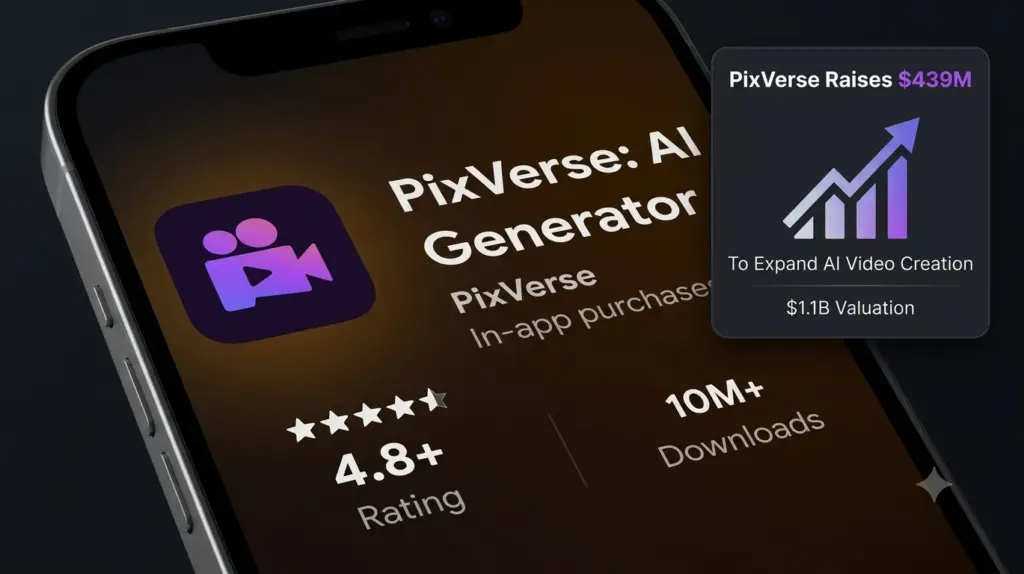
There’s a new name to know in AI video, and it just backed up its ambitions with one of the bigger checks in the space this year. PixVerse raised $439M valuation territory north of $2 billion, closing out an extended Series C round that pulled in a genuinely eclectic mix of backers, from Alibaba to Mirae Asset to a handful of firms most people outside Singapore’s VC scene have never heard of.
If you haven’t been tracking PixVerse closely, that’s fair. The company has mostly built its name quietly, growing a consumer video-generation app to over 150 million registered users while the bigger, louder players in the space OpenAI, Meta, Runway soaked up most of the headlines. But the fact that PixVerse raised $439M valuation of this size tells you something’s shifted. Investors aren’t just betting on another video generator. They’re betting on what PixVerse is building next. Also Read How Is Agentic AI Different from Traditional Chatbots?
Table of Contents
How PixVerse Raised $439M Valuation to Cross the Unicorn Line
The round itself has an interesting shape. PixVerse first crossed unicorn status back in March, when it closed an initial Series C anchored by CDH Investments. That’s usually where the story ends for most startups — you raise, you announce, you move on. Instead, PixVerse kept the round open and quietly extended it, pulling in a fresh wave of investors including Alibaba, Lollapalooza Capital, Ivy Capital, Grand Mount Capital, Eastern Bell Capital, Mirae Asset, BlueFocus, and CloudAlpha, alongside returning backers iGlobe Partners and OCBC’s LionX Ventures.
By the time the extension closed this week, PixVerse raised $439M valuation for the whole Series C round, and the company’s overall valuation pushed past $2 billion. That’s a big jump for a company founded in 2023, and it puts PixVerse in the same conversation as the handful of AI video startups actually pulling ahead of the pack rather than just keeping up.
Why Investors Bet Big When PixVerse Raised $439M Valuation
So why did this round attract so much attention? Part of it is timing. Co-founder Jaden Xie has pointed out that the field has actually thinned out lately rather than gotten more crowded OpenAI stepped back from the video business when it shut down Sora 2, and neither Meta nor Tencent has managed to ship a video model that’s turned heads. That leaves a narrower set of companies actually pushing the technology forward, and PixVerse has positioned itself firmly in that group.
The other part is technical. PixVerse’s pitch isn’t really about having more data than everyone else — it’s about labeling that data better. Co-founder Wang Changhu, who spent years working on computer vision at ByteDance, built the labeling technology that the company says gives its outputs an edge in accuracy and consistency. When PixVerse raised $439M valuation worth of new capital, a good chunk of investor confidence was riding on that specific claim: that better-labeled training data beats simply having more of it. Also Read What is Mistral AI? Everything You Should Know About OpenAI’s Competitor
What Happens Now That PixVerse Raised $439M Valuation
Money like this doesn’t just sit in the bank. PixVerse has already laid out where it’s headed, and the plan is bigger than just making better videos. The company’s R-Series world models, first introduced earlier this year, are being pushed into an entirely new direction: the PixVerse Game Engine, a system where a game world is generated in real time as a player interacts with it, rather than pre-built by developers ahead of time.
CEO Wang Changhu described it directly the world a player is in isn’t rendered in advance, it’s generated continuously based on what the player actually does. That’s a genuinely different foundation for building games than anything the industry has shipped before, and it’s a big part of why PixVerse raised $439M valuation rather than a more modest round. Investors weren’t just funding better video clips. They were funding a bet on interactive, generative worlds. Also Read What Are the Best AI Tools for Graphic Design?
The company is also pushing into real-time interactive livestreaming, where AI-generated characters can respond to an audience live, opening the door to new kinds of virtual hosting and audience-driven entertainment that didn’t really exist as a product category before this year

The Bigger Picture Behind the Raise
There’s a wider trend sitting underneath this story. AI video generation has quietly become one of the more contested corners of the industry, with Kling AI, ByteDance’s Seedance, Runway, Luma, and Midjourney all fighting for the same slice of attention. What sets this round apart is that PixVerse raised $439M valuation not to compete harder on video quality alone, but to pivot part of its business toward something adjacent and arguably bigger: interactive, real-time generated worlds that blur the line between watching content and playing inside it.
Whether that bet pays off the way the company hopes remains to be seen. But with 150 million users already on the platform and fresh capital in the bank, PixVerse has bought itself the runway to find out and given how quickly the AI video space is moving, that runway might matter more than the current product roadmap ever could.