
You’ve used a chatbot before. You typed a question, it gave you an answer. Sometimes it was useful. Sometimes it sent you in three circles before you gave up and called the actual support line. That experience helpful in a narrow lane, frustrating the moment you leave it is the ceiling of traditional AI chatbots. And in 2026, a new category of AI is making that ceiling look very low.

Agentic AI different from traditional AI chatbots is one of those topics that sounds technical but matters to anyone using or building with AI right now. The gap between the two is not a small upgrade. It’s a fundamental shift in what AI can actually do from answering questions to completing tasks, from responding when asked to acting on its own, from single-step replies to multi-step execution across real tools and systems. ,Here’s what that actually means, why it matters, and where the line sits. Also Read: What Are the Best AI Search Visibility Tools in 2026
Table of Contents
What is Agentic AI and Agentic AI Different from Traditional Chatbots?
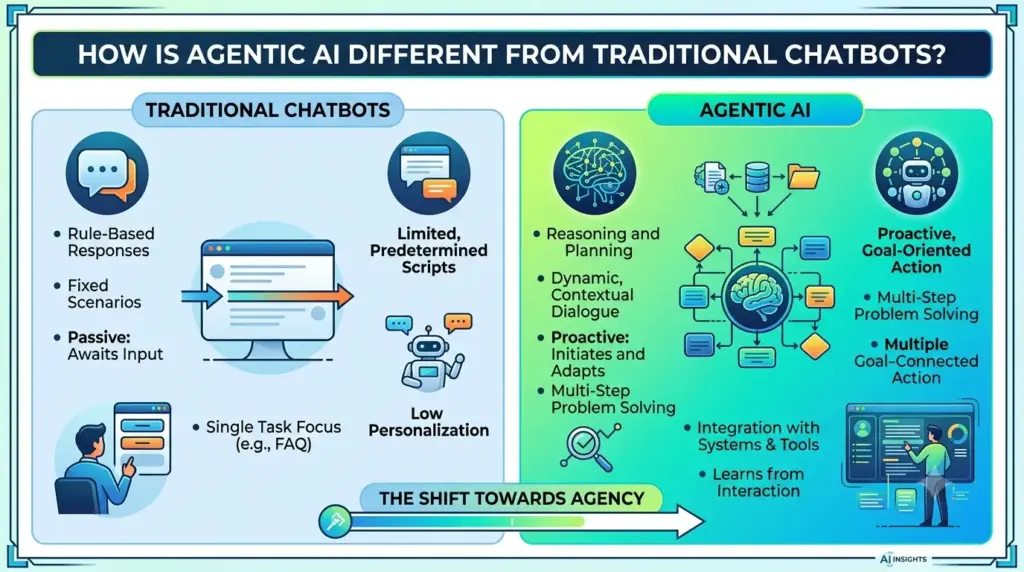
The short definition: agentic AI refers to AI systems that can set goals, plan how to achieve them, take action across multiple tools and systems, and adapt based on what happens without needing a human to guide every step.
That’s a different thing from a chatbot. A chatbot waits for your input, processes it, and returns a response. One round of conversation at a time. An agentic AI system receives a goal and figures out the steps required to achieve it. It breaks the goal into tasks, uses the tools it has access to, makes decisions along the way, and keeps going until the job is done or until it hits a decision that requires human approval.
The reason everyone is talking about it in 2026 comes down to one number: Gartner projects that 40% of enterprise applications will feature task-specific AI agents by the end of 2026, up from less than 5% in 2025. That’s not a gradual shift. That’s most of enterprise software changing how it works inside a single year.
The underlying technology that made this possible better large language models, cheaper inference costs, standardized protocols for connecting AI to external tools reached a practical maturity threshold in late 2024 and early 2025. Two protocols in particular changed the infrastructure: Anthropic’s Model Context Protocol (MCP), introduced in November 2024 as an open standard for connecting AI systems to external tools and databases, and Google’s Agent-to-Agent (A2A) protocol for agent-to-agent communication. These created the connective tissue that agentic AI needed to actually operate in the real world, not just in demos.
The shift from “ask and answer” to “observe and act” is the most significant evolution in enterprise AI since the launch of ChatGPT. And it’s what makes agentic AI different from traditional AI chatbots in a way that goes beyond feature comparison.
What are AI agents, and how do they work?
An AI agent is a system built on a large language model that adds four things a standard chatbot doesn’t have: memory, planning, tool access, and autonomy.
Memory — a traditional chatbot operates within a single conversation window. Once the session ends, context is gone. An AI agent maintains state across interactions. It remembers what happened in previous sessions, what tasks have been completed, what information was gathered, and what still needs to happen.
Planning — a chatbot receives a prompt and produces a response. An agent receives a goal and creates a plan. It breaks the objective into sub-tasks, identifies what it needs to complete each one, sequences the steps, and works through them. If something doesn’t work, it adjusts.
Tool access — this is where it gets real. AI agents can connect to external systems. A database. A CRM. An email client. A calendar. A web browser. A code execution environment. They don’t just talk about doing things they do them. An agent asked to “schedule a meeting with the three people who responded to my proposal” can actually read your emails, identify the respondents, check calendar availability, send invites, and confirm bookings. No human clicking anything.
Autonomy — a chatbot is reactive. It waits for you to say something. An agent is proactive. It can monitor for conditions and take action when those conditions are met, without being prompted. Set a goal, give it access to the right tools, and it works toward that goal independently only pausing when it reaches a decision that needs human judgment.
Technically, an AI agent consists of a language model at the core, tools it can call, memory storage, knowledge sources, and safety controls that define what it’s allowed to do and when to ask for approval. The whole system works in a loop: perceive what’s happening, decide what to do, act, observe the result, and decide what to do next.
In 2026, the agentic AI market is projected to grow from $7.06 billion toward a trajectory that reflects how fast enterprise adoption is actually moving. The products at the frontier include OpenAI’s Operator (launched January 2025, integrated into ChatGPT as “agent mode” by July 2025), which can navigate websites, fill forms, place orders, and complete multi-step browser tasks with partners including DoorDash, Instacart, OpenTable, Uber, and Etsy. Claude Code operates as a terminal-native agent that reads, writes, refactors, and debugs across entire codebases. Google’s Antigravity coordinates multiple agents in parallel. Also Read: Google Omni: What It Is, What It Does, and Why People Are Talking About It
The Fundamental Gap — What Makes Agentic AI Different from Traditional AI Chatbots
Traditional chatbots are built on a simple model: a user sends a message, the system produces a response, the conversation moves forward one step at a time with a human driving every turn.
What makes agentic AI different from traditional AI chatbots isn’t just capability. It’s the entire operational model.
A traditional chatbot is like a knowledgeable desk clerk. You ask a question, they answer. You ask another, they answer that. They’re helpful as long as you know what to ask. The moment you need someone to actually go do something for you coordinate across departments, check multiple systems, execute a series of actions the desk clerk hands you a phone number and tells you to call.
An AI agent is the person who takes your request, figures out who needs to be involved, makes the calls, follows up, and comes back with the completed result.
Here’s what that looks like in concrete terms:
Customer support scenario: A traditional chatbot answers “What is your return policy?” An AI agent receives “I need to return these three items, two were damaged and one was the wrong size” verifies the order, checks eligibility for each item individually, initiates three separate return processes, schedules a pickup, and sends confirmation emails. Same interaction starting point. Completely different outcome.
Healthcare scenario: A traditional chatbot books an appointment. An AI agent handles the full patient journey appointment booking, pre-visit intake forms, reminder messages, follow-up scheduling, medication refill requests, and updates to the patient record. All without a human touching the workflow.
Finance scenario: A traditional chatbot answers questions about your account balance. An AI agent handles a loan application collecting documents, running KYC checks, verifying income, scoring the application, and routing for approval reducing a process that took days to hours.
The distinction is real and it’s the reason Gartner projects enterprise agent adoption jumping from under 5% to 40% in a single year. Also Read: How SpaceX launches Starship V3 for the first time but with no Booster on Return
The Key Differences Side by Side
This is where the comparison becomes concrete. Here’s exactly what separates agentic AI different from traditional AI chatbots across the dimensions that matter:
| Dimension | Traditional AI Chatbot | Agentic AI |
|---|---|---|
| How it operates | Reactive — responds when prompted | Proactive — acts toward goals independently |
| Task handling | Single-step responses | Multi-step task execution |
| Memory | Session-only (resets each conversation) | Persistent across sessions and tasks |
| Tool access | None or very limited | Full integration with external tools and systems |
| Decision-making | Follows script or fixed intent model | Reasons, plans, adapts based on outcomes |
| Human involvement | Required at every step | Required only at defined approval points |
| Context awareness | Within the current conversation only | Across conversations, systems, and time |
| Best suited for | FAQs, structured queries, simple support | Complex workflows, multi-system tasks, autonomous operations |
| Failure mode | Gives wrong answer or fails to understand | Takes wrong action (higher stakes, needs guardrails) |
The failure mode distinction at the bottom is worth paying attention to. A chatbot’s worst case is a bad answer you can ignore. An agentic system’s worst case is a bad action taken on your behalf. That’s why human-in-the-loop controls, defined permission boundaries, and audit trails are central to agentic AI architecture in a way they never were for chatbots.
Where It Gets Complicated — The Autonomy Question
The fact that agentic AI different from traditional AI chatbots in its ability to act raises a real question: how much autonomy do you actually want?
The answer in 2026 is: it depends on the task, and it should be a conscious design decision rather than a default.
Agentic systems in production use today operate on a spectrum. At one end, a “human-in-the-loop” agent pauses for approval before taking any consequential action — drafting an email before sending, showing a recommended trade before executing, flagging a document for review before filing. At the other end, a “human-on-the-loop” agent operates autonomously and surfaces summaries for human review after the fact, only escalating when something falls outside its defined parameters.
The right setting depends on the stakes of the task, the quality of the model, and how much you trust the system’s judgment in a given domain. A coding agent running tests can be given full autonomy the worst case is a broken test. An agent managing financial transactions needs tighter controls with human approval at each stage.
Most enterprise deployments in 2026 are running with human-in-the-loop on high-stakes decisions and human-on-the-loop on lower-stakes operational tasks. The balance shifts as trust in specific agents builds over time. Also Read: How Is AI Being Used in FIFA World Cup 2026?
Why 2026 Is the Year This Actually Matters
The technology for agentic AI has been theoretically possible for longer than most people realize. What changed in 2025 and 2026 was the practical infrastructure.
LLM inference became cheap enough to run agents economically. Function calling the ability for a model to invoke external tools became standardized across providers. RAG (Retrieval-Augmented Generation) and persistent memory became reliable in production environments. And MCP created a neutral standard for connecting models to external systems, similar to what USB-C did for device connectivity.
Teams adopting agents earlier aren’t getting magic AI. They’re getting better operational discipline. Leads get structured. Documents become findable. Emails don’t get lost between systems. Workflows that required three people and a shared spreadsheet now run on a single agent that handles the orchestration.
That practical shift from demo to working automation is the reason the enterprise adoption numbers are moving as fast as Gartner projects. It’s also why understanding what makes agentic AI different from traditional AI chatbots matters right now rather than as a future-looking exercise.
Which One Do You Actually Need?
Not every problem needs an AI agent. Traditional chatbots still solve real problems at lower cost and complexity for the right use cases.
Stick with a traditional chatbot if:
- Your use case involves structured, predictable queries with known answers
- You need fast deployment without complex integration work
- The conversation doesn’t require action across external systems
- Budget is constrained and the tasks are truly repetitive FAQ-style interactions
Move to agentic AI when:
- The workflow spans multiple systems or steps
- Context needs to persist across sessions
- You want automation that actually executes not just advises
- The task requires judgment and adaptation based on intermediate outcomes
- Human oversight is needed at decision points, not at every single step
Banks use chatbots for account balance queries and agentic AI for loan applications and KYC checks. Healthcare organizations use chatbots for appointment booking and agentic AI for patient follow-ups, record updates, and medication management. The two categories coexist they just serve different tiers of complexity.
The question of how agentic AI different from traditional AI chatbots has a clear answer in 2026: the difference is autonomy, memory, tool access, and the ability to complete multi-step tasks without human direction at every turn.
A chatbot talks. An agent does. That sounds like a simple distinction until you map it against the actual workflows that drive business operations customer onboarding, supply chain coordination, financial processing, software development, security monitoring. In those contexts, the gap between a system that answers and a system that acts is the gap between a tool you consult and infrastructure you depend on. That’s what makes this shift worth understanding before it shows up in the tools you’re already using which, by the end of 2026, it almost certainly will.