
The FIFA World Cup 2026 kicked off on June 11 and is now underway across the United States, Canada, and Mexico. Organizers are calling it the most technologically advanced tournament in football history. With 48 teams, 104 matches, and 16 host cities, the scale alone is unprecedented. But the real story this summer is how is AI being used in FIFA World Cup 2026 from the ball on the pitch, to the camera on the referee’s head, to the facial scanner at the stadium gate.
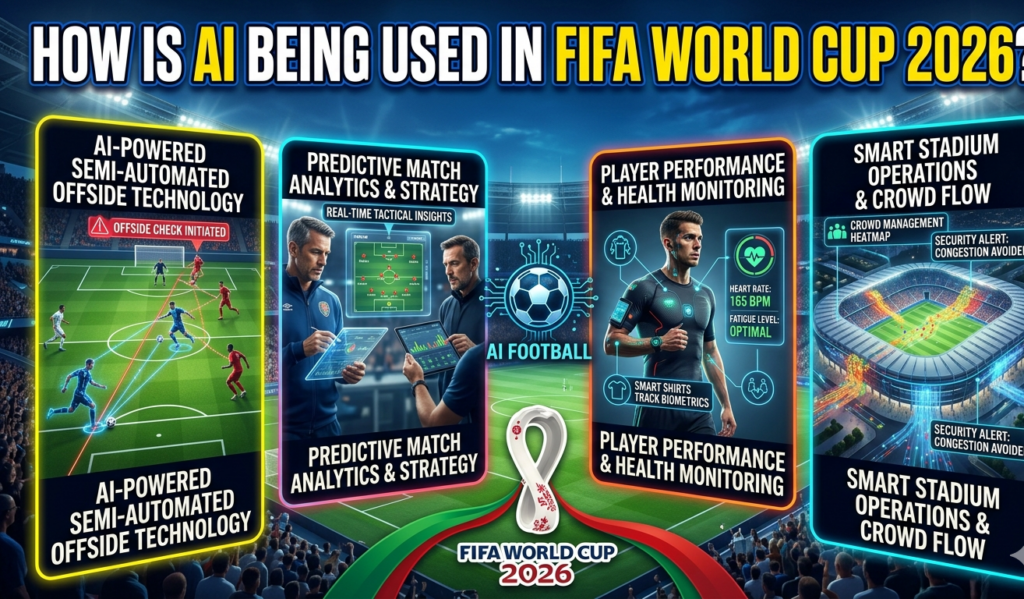
Quick answer: AI is helping make offside calls faster, stabilizing referee body-cam footage, powering a free analytics tool for all 48 teams, driving fan-facing features in Google Search and Maps, and running facial-recognition security at several US stadiums. Final judgment calls like offside interference still belong to human officials. Here’s a full breakdown of where AI actually shows up, and what it is (and isn’t) allowed to decide. Also Read: How to Recover Deleted Photos on iphone and Android?
Table of Contents
How Is AI Being Used in FIFA World Cup 2026? AI and the Smarter Offside System
The most visible AI upgrade for 2026 builds on semi-automated offside technology (SAOT), first used at the 2022 Qatar World Cup.
This year’s version adds AI-enabled 3D player avatars. Every player gets a roughly one-second digital body scan before the tournament. The system uses that model to track them even during fast or visually blocked movement.
FIFA says the upgrade cuts average offside review time by about 30 seconds. Clear-cut positional offside calls can now go straight into the assistant referee’s earpiece, instead of always triggering a full video review.
It’s worth being precise about what’s automated here. AI determines where a player was standing and the exact moment the ball was played — a measurable, positional question.
Whether that player actually interfered with play is still a judgment call. That decision stays with a human referee.
The Match Ball Is Now a Data Source
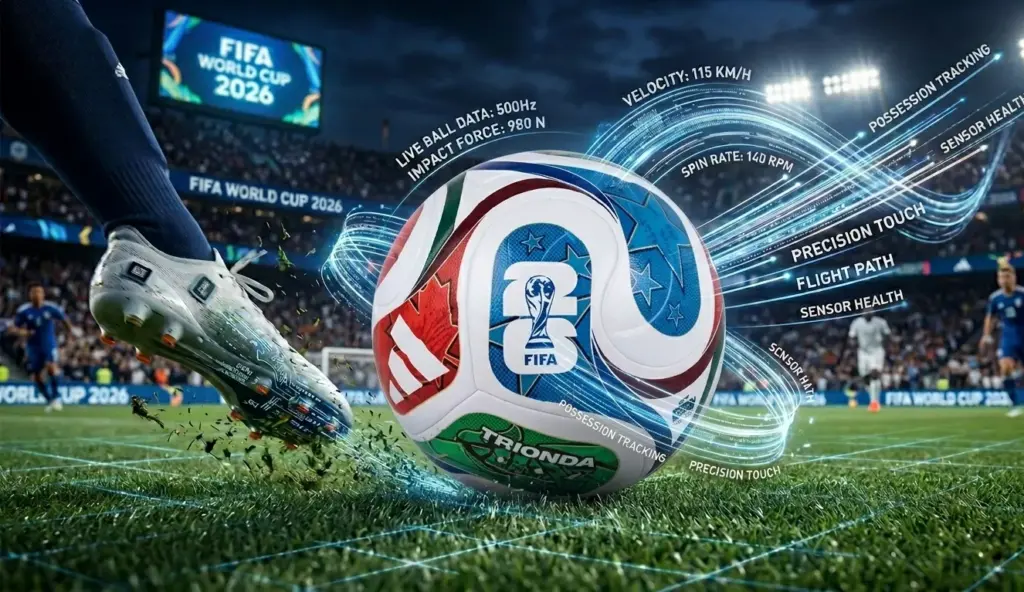
This year’s official ball, the adidas Trionda, carries a 500Hz motion sensor built into one of its four panels. The sensor logs the exact moment of every touch. It sends that data to the video assistant referee (VAR) system in real time.
This helps officials pinpoint exactly when a pass was played critical for tight offside calls. It also helps flag handballs or marginal touches in crowded penalty-area moments. One quirk: the ball needs to be charged before each match to keep its sensor running.
AI-Stabilized Referee Cameras
For the first time, match officials across all 104 games are wearing body cameras, mounted near the ear. The feed runs through a system FIFA calls Referee View.
Raw head-mounted footage is normally almost unwatchable — it shakes with every stride. So FIFA runs it through AI-powered stabilization software in real time.
FIFA reports this cuts visual distortion by roughly 50%. That turns shaky raw footage into something broadcasters can actually air, giving fans a referee’s-eye view of contested moments.
The system was trial-run at the 2025 FIFA Club World Cup before this tournament-wide rollout. Footage still goes through editorial review before release. Also Read: How to Speed Up a Slow Android Phone in 2026
Football AI Pro: Leveling the Field Between Rich and Poor Federations
Away from the pitch, FIFA’s centerpiece AI tool is Football AI Pro — a generative AI assistant built with Lenovo on FIFA’s own football data model.
It draws on hundreds of millions of FIFA data points. Coaches can ask natural-language questions and get text summaries, stats, and even 3D tactical reconstructions.
Critically, it’s free to all 48 competing federations — not just the wealthiest ones. That directly targets a long-standing imbalance, since big-budget national teams have always had access to deeper analytics departments.
One limit: the tool is for pre- and post-match use only. It doesn’t feed live, in-game decisions.
Several national teams have also built their own AI partnerships on top of this. Google’s Gemini is reportedly working with Argentina, France, Brazil, Morocco, and the United States on formation analysis and opponent scouting.

AI for Fans: Stadium and App Experience
For fans watching at home or in the stadium, AI shows up in quieter but constant ways.
Google has added World Cup-specific AI features to Search, Maps, and Waze. These generate real-time match visuals and tactical graphics alongside live scores.
Inside several stadiums, AI-driven AR overlays can show player names, speed, and movement data directly on a fan’s phone during play.
On the moderation side, FIFA’s Social Media Protection Service scans roughly 30,000 keywords across Facebook, Instagram, YouTube, and TikTok (not X, which doesn’t participate). Abusive posts aimed at players can be hidden within about two seconds. Repeat offenders can be barred from buying tickets to future matches.
AI Security and the Surveillance Debate
Not every AI application at this World Cup is about better replays. This is the part of the story drawing the most criticism.
Several US stadiums — including Gillette Stadium (Boston), Hard Rock Stadium (Miami), and Mercedes-Benz Stadium (Atlanta) — use AI-powered facial recognition for entry and in-venue payments. Fans can use their face instead of a ticket or card.
Robotic patrol units are operating in Dallas, New Jersey, and parts of Mexico. The US Department of Homeland Security has committed roughly $365 million to World Cup security tech, including counter-drone systems.
Civil liberties groups have pushed back hard. More than 120 organizations, including the ACLU and Amnesty International, issued a joint travel advisory warning fans about facial recognition exposure. Some advised disabling face-unlock on personal phones before arriving. Also Read: How to use Notion AI to organize your entire life?
The core concern isn’t really about the six-week tournament itself. It’s what stays behind afterward — surveillance infrastructure installed for an event like this tends to remain active long after it ends. Qatar’s roughly 15,000 World Cup cameras from 2022 are often cited as the preview of this pattern.
The Infrastructure Behind It All
Behind both the highlight-reel uses and the more controversial ones sits a large, unglamorous tech backbone.
Lenovo, FIFA’s official technology partner, has deployed servers at the International Broadcast Centre in Dallas. It’s running over 17,000 devices and roughly 200 on-site engineers, aiming for under five seconds of video latency.
Lenovo has also built digital twins of all 16 stadiums, simulating crowd flow in real time. That feeds into a central FIFA Intelligence Command Centre pulling in data from venues, broadcasters, and security teams at once.
Cybersecurity researchers have flagged the tournament as a major target for fake ticketing sites and phishing campaigns, given the sheer number of fans and payment systems involved across three countries.
Frequently Asked Questions
Is AI replacing referees at the World Cup 2026? No. AI measures positions and ball contact, but humans still make judgment calls like offside interference and disciplinary decisions.
What is Football AI Pro? A free, generative AI analytics tool built by FIFA and Lenovo, available to all 48 teams for pre- and post-match preparation — not live decisions.
Does the 2026 World Cup use facial recognition? Yes, at several US stadiums, including Gillette, Hard Rock, and Mercedes-Benz, for entry and payments. It has drawn criticism from civil liberties groups.
What technology is inside the adidas Trionda ball? A 500Hz motion sensor that sends real-time touch and movement data to the VAR system to support offside and handball calls.
The Bottom Line
How is AI being used in FIFA World Cup 2026? Almost everywhere, but in two different registers.
One side is genuinely useful and fairly uncontroversial: faster offside calls, smoother referee footage, free tactical analytics for every team, and abuse moderation that protects players.
The other side is a security and biometric infrastructure raising real questions about consent and data retention. Both are running at once, across the same 16 stadiums — and how that balance gets judged may depend less on the football than on what happens to all that data after the trophy is lifted on July 19.