You can rank number one on Google and still be completely invisible in ChatGPT. That’s not a hypothetical. It’s happening to brands right now. Someone types a question into Perplexity or Google AI Overviews, gets a direct answer, and never clicks through to a website. If your brand isn’t in that answer you don’t exist for that person. Doesn’t matter where you rank on the blue links. Lets Discover, what Are the Best AI Search Visibility Tools.
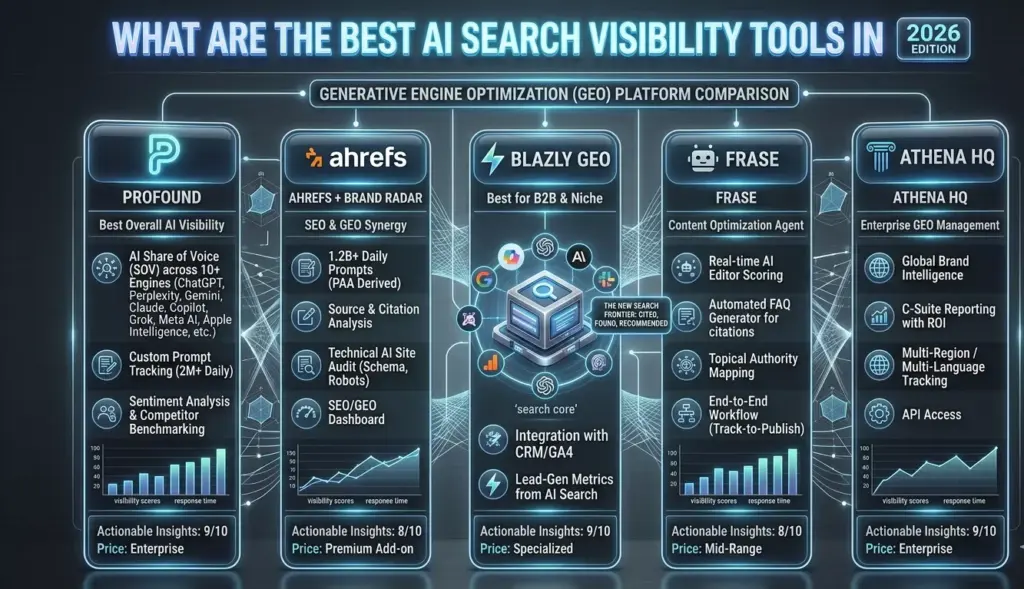
Well, This is the problem AI search visibility tools were built to solve. They track how often your brand appears in AI-generated responses across ChatGPT, Google AI Overviews, Perplexity, Gemini, and others. Some go further, they tell you why you’re not showing up and help you fix it. Also Read: Google Omni: What It Is, What It Does, and Why People Are Talking About It
There are dozens of tools in this space now. The market raised over $300 million in funding between mid-2025 and early 2026. So the options are real, the pricing varies wildly, and knowing which one is actually worth it takes some sorting through. Here’s that sorting.
Table of Contents
What Are the Best AI Search Visibility Tools and Why AI Search Visibility Is a Separate Problem From SEO?
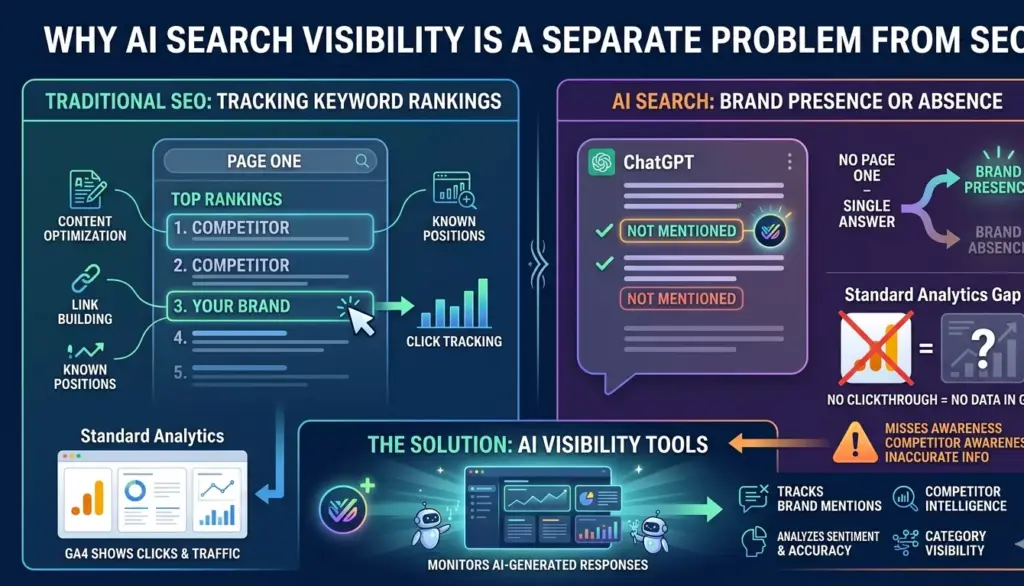
Traditional SEO tracks keyword rankings. You know where you sit on page one for a given query. You optimize content, build links, watch the numbers move.
AI search doesn’t work that way. When someone asks ChatGPT a question, there’s no page one. There’s an answer — and either your brand is mentioned in it or it isn’t. No clicks to track. No position to rank. Just presence or absence.
Standard analytics tools miss this almost entirely. If ChatGPT mentions your brand but no one clicks through, your GA4 shows nothing. You have no idea whether AI platforms are driving awareness, sending people to competitors, or saying something inaccurate about you altogether. Also Read: Grammarly vs QuillBot vs ChatGPT: best AI writing assistant?
That’s what AI visibility tools fix. They monitor those AI-generated responses and tell you what’s actually being said about you, about your competitors, and about your category.
The Best Tools Right Now
1. Profound — Best for Enterprise Teams
Profound is the category leader. It raised $155 million, hit a $1 billion valuation, and counts Fortune 500 companies among its clients. That context matters because the product and pricing are built for organizations at that scale.
What it does: tracks share of voice, brand sentiment, and citations across ten-plus AI engines. The feature set is probably the most complete in the market visibility analytics, citation tracking, prompt volume data, agent analytics, and content workflow tools all in one platform.
The catch it starts at $499 per month, and the $99 Starter plan is too limited for meaningful use. The Starter plan gives you ChatGPT only with 50 prompts and no exports. For actual work, you’re looking at the higher tiers.
Best for: Large brands and agencies with dedicated SEO or GEO teams and budgets to match.
Starting price: $499/month (practical entry point)
2. Peec AI — Best for Mid-Market Teams
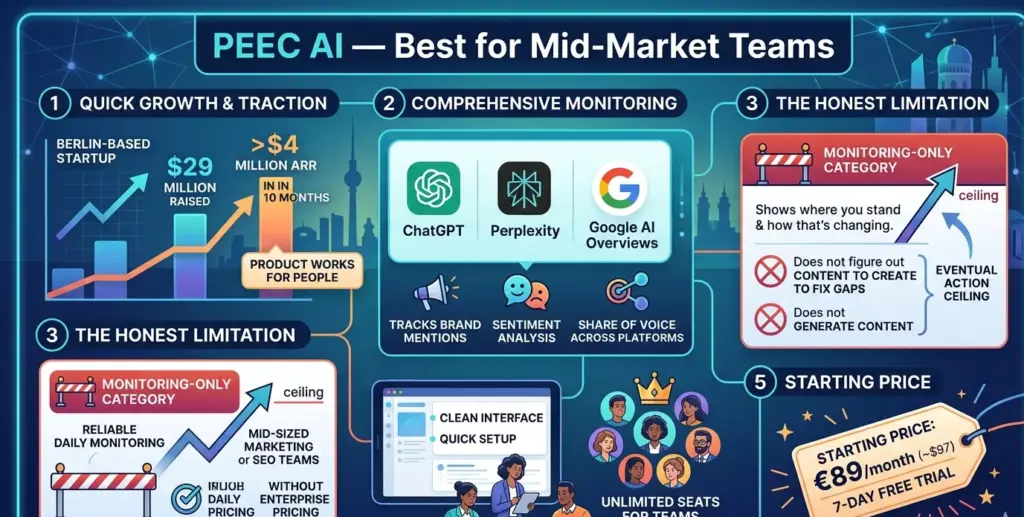
Peec AI is based in Berlin and has grown fast $29 million raised and over $4 million in annual recurring revenue within ten months of launch. That kind of traction usually means the product is actually working for people.
It tracks brand mentions, sentiment, and share of voice across ChatGPT, Perplexity, and Google AI Overviews. The interface is clean, setup is quick, and it supports unlimited seats which matters for teams where multiple people need access without extra charges.
The honest limitation: Peec sits in the monitoring-only category. It shows you where you stand and how that’s changing. It doesn’t help you figure out what content to create to fix gaps or generate that content for you. If you want to move from measurement into action, you’ll hit the ceiling eventually.
Best for: Mid-sized marketing or SEO teams who want reliable daily monitoring without enterprise pricing.
Starting price: €89/month (~$97) with a 7-day free trial
3. Otterly AI — Best Entry-Level Option
Otterly launched when most teams were still tracking AI visibility manually running ChatGPT prompts by hand, taking screenshots, pasting into spreadsheets. It automated that process and built trend data on top. For that, it earned a real reputation in GEO circles early on.
Today it’s the most affordable structured entry point into AI visibility tracking, with a Lite plan at $29/month. It covers ChatGPT, Google AI Overviews, Perplexity, and Microsoft Copilot as core platforms, Gemini and AI Mode are add-ons at extra cost.
The tradeoff at lower tiers is prompt limits. The Lite plan gives you 15 prompts. Standard gets you 100 prompts at $189/month. Pro is 400 prompts at $489/month. If you have a lot of keywords to monitor or multiple brands, the costs climb quickly. Also Read: Best AI tools for small businesses in 2026
It also doesn’t have content creation features. Pure monitoring, which is fine if that’s all you need right now.
Best for: Teams just starting with AI visibility who want to see the data before committing to a bigger tool.
Starting price: $29/month (Lite)
4. Semrush AI Toolkit — Best for Existing Semrush Users
If you’re already paying for Semrush, the AI Toolkit is probably the least disruptive way to add AI visibility tracking to your workflow. It layers onto the SEO suite you already use rather than requiring a separate tool and login.
It tracks performance in AI Overviews and major chatbots from inside the Semrush interface and includes competitive AI research, so you can see how rivals are showing up across platforms and find the gaps. The “checks” pricing model (one keyword, one engine, one location per check) makes it scalable for high-volume tracking across many prompts.
The depth isn’t as strong as dedicated AI visibility platforms. But for teams that prioritize keeping their stack consolidated, it’s a practical choice.
Best for: SEO teams already on Semrush who want AI tracking without adding another tool.
Starting price: $139.95/month (Semrush One, which includes AI Toolkit)
5. Nightwatch — Most Complete Technical Option
Nightwatch stands out because it combines AI visibility monitoring with traditional SEO data in a way that most dedicated AI tools don’t bother with. You get LLM monitoring, search engine tracking for AI lookups, prompt research capabilities, and citation-level sentiment analysis alongside standard rank tracking.
For teams that don’t want to maintain separate platforms for traditional SEO and AI visibility, Nightwatch handles both reasonably well. The prompt research feature is specifically useful it helps you find which questions AI platforms are actually being asked in your category, so you know what content to go after.
Best for: Teams wanting AI visibility and traditional SEO tracking without running two separate platforms.
6. Knowatoa AI — Best for Brand Monitoring Depth
Knowatoa takes a more focused angle. Instead of just tracking whether your brand shows up, it tracks specific brand attributes product names, leadership details, key differentiators, positioning claims. That level of detail is useful if you’re managing how a brand is represented across AI platforms, not just whether it appears.
It monitors seven major AI platforms, ChatGPT, Claude, Perplexity, Gemini, Google AI Overviews, Meta AI, and AI Mode and processes up to 21,700 responses monthly. Multi-language and multi-region support is included, which matters for brands operating across markets.
Best for: Brand teams and agencies doing deep-dive reputation monitoring across multiple platforms.
Quick Comparison Table
| Tool | Starting Price | AI Engines Covered | Content Help | Best For |
|---|---|---|---|---|
| Profound | $499/mo | 10+ | Yes | Enterprise |
| Peec AI | €89/mo | 3 core | No | Mid-market teams |
| Otterly AI | $29/mo | 4 core + add-ons | No | Beginners |
| Semrush AI Toolkit | $139.95/mo | Multiple | Limited | Existing Semrush users |
| Nightwatch | Varies | Multiple | Limited | SEO + AI combined |
| Knowatoa AI | Custom | 7 | No | Brand monitoring |
What to Actually Look For When Picking One
The feature lists across these tools all sound similar. A few things actually separate them in practice.
Real interface tracking vs API calls. Some tools monitor AI responses through the actual user-facing interface. Others make API calls to the model directly. The difference matters real AI search includes web citations, live retrieval, and context that API-only approaches miss. If accuracy is important, ask the vendor how they’re actually pulling responses.
Monitoring only vs monitoring plus fixing. Most tools show you where you’re invisible. Fewer help you do something about it. If you’re at the stage where you just want to understand the landscape, monitoring-only tools are fine. If you want to move from measuring gaps to closing them, make sure the tool offers content recommendations or generation on top of tracking. Also Read: Nord VPN vs Surfshark VPN: Which is best in 2026?
Engine coverage that matches your audience. Profound monitors 10+ engines on Enterprise. Otterly covers 4 core platforms. Before paying for broad coverage, figure out which AI platforms your actual audience uses. Paying for Claude and Meta AI monitoring when your users are all on ChatGPT and Perplexity is wasted budget.
Prompt limits and how fast you’ll hit them. Otterly’s $29 plan sounds accessible until you realize 15 prompts per month won’t cover much for an active brand. Map your actual monitoring needs against the prompt limits before committing.
The Bigger Picture
AI search visibility is a new enough category that the tools are still maturing. Some features that seem essential today may be standard across all platforms in six months. New entrants are launching constantly.
What isn’t changing: the shift toward AI-generated answers is real and accelerating. Gartner has predicted that 25% of organic search traffic will shift to AI chatbots through 2026. Whether that exact number proves accurate or not, the direction is clear enough that ignoring AI visibility is increasingly a real risk.
Start with what your budget allows, track the platforms your audience actually uses, and revisit your tool selection every few months as the category evolves. The wrong choice isn’t picking the second-best tool, it’s waiting so long to start that you have no data when you finally need it.