
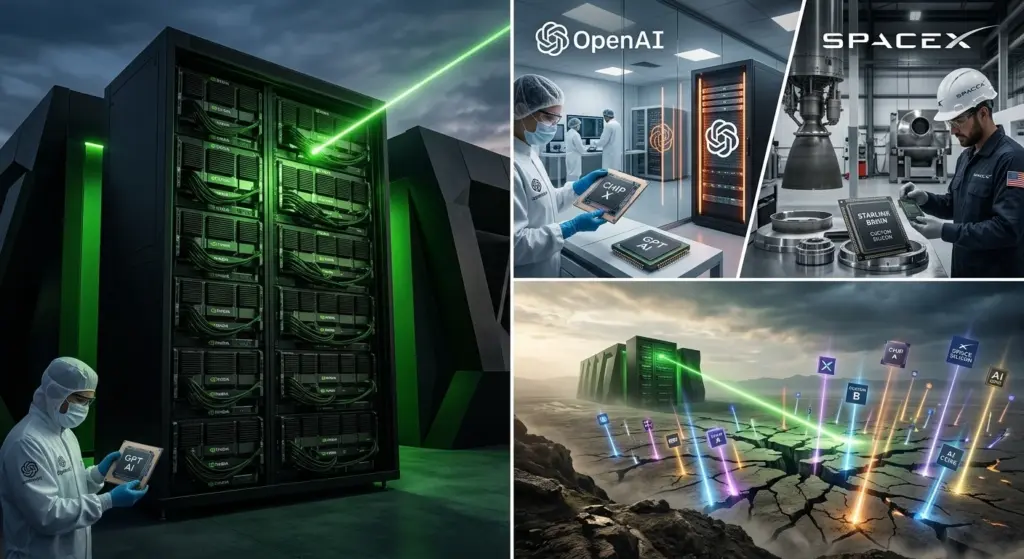
Open to Spacex is building their own chips. So is basically everyone else with enough money and enough desperation for compute right now. If you’ve scrolled through tech Twitter or LinkedIn in the last few weeks, you’ve probably seen the headlines fly by a new chip name here, a Broadcom deal there. It looks random from the outside. It isn’t. This is a years-long, extremely expensive bet, and companies don’t make that kind of bet on a whim.
For most of the last decade, Nvidia basically owned this space. You needed to train a model, run inference, whatever you bought Nvidia. There wasn’t really a conversation to have about it. That’s not really true anymore. Open to Spacex is building their own chips because, at a certain scale, buying someone else’s hardware stops being convenient and starts being a constraint. And the companies bumping up against that ceiling are exactly the ones you’d expect: the ones burning the most compute, the fastest. Also Read Why Are Companies Investing Billions in AI Infrastructure?
Table of Contents
The Jalapeño Moment
OpenAI’s the one everyone’s talking about at the moment. Back in June 2026 they showed off their first custom chip built with Broadcom, and named, for reasons nobody has fully explained, Jalapeño. Not a side project. Not a “someday” plan. A real inference chip built to run ChatGPT and Codex at the scale OpenAI actually operates at. And there’s a detail in here that I still find a little unsettling, in a good way: OpenAI’s own models helped design it. The AI helped build the hardware that’ll run the next AI. Sit with that for a second.
Early samples are in testing now. So far, the numbers being floated are something like a 50% cost saving versus a typical GPU setup assuming that holds once this thing is actually running at scale, which is a big assumption, but still. And the timeline is almost more interesting than the chip itself: design to manufacturing tape-out in about nine months. Broadcom’s calling it the fastest ASIC turnaround in the history of high-performance chips. Maybe that’s marketing. Maybe it’s true. Either way, nine months is fast.
Why bother with any of this? Because OpenAI literally cannot buy enough compute. Not “would like more.” Cannot get enough, full stop that’s straight from leadership, and Broadcom’s CEO backed it up, calling demand insatiable and saying it’s not slowing down through 2027, maybe 2028. When the shortage is that bad, you stop waiting in line.
Meanwhile, SpaceX
OpenAI’s getting the press, but SpaceX has been at this way longer, just quieter about it. Open to Spacex is building their own chips isn’t a new idea for them at all it’s closer to a decade-long habit at this point. Starlink’s custom silicon has been co-designed in-house for years. What’s changed lately is the scope. SpaceX is now moving into chip categories it used to just buy off the shelf.
There’s a job posting — the kind of thing that leaks these plans before any press release does — describing custom RF chip modules built specifically for phones connecting to Starlink Mobile. Multi-chip modules, covering all the RF front-end work for 5G, LTE, Wi-Fi. And this isn’t research-lab stuff. The listing talks about production boards, yield analysis, high-volume manufacturing. That’s a company gearing up to make a lot of these, not tinker with a prototype.
It fits everything SpaceX has done for years. Building your own ASICs instead of buying them gets you control — radiation hardening tuned exactly to your mission, no dependence on some outside vendor’s inventory, and costs that pay for themselves fast once you’re running thousands of satellites instead of a handful. A custom chip built for one job beats a generic part almost every time, once you’re operating at that scale. Also Read How Is Agentic AI Different from Traditional Chatbots?
Why Nvidia Keeps Losing Its Biggest Customers
So why has this gone from rare to routine? A few things keep showing up.
Cost, obviously. Nvidia’s chips are general-purpose built to do a lot of things reasonably well. That flexibility isn’t free. If your company only ever runs one kind of workload, you’re paying for capability you’ll never touch. Cut that away and build only for the job you actually have, and the savings stack up quickly.
Then there’s just supply. Nvidia can’t make chips fast enough for everyone who wants them, full stop. When the gap between demand and supply gets that wide, the companies with money and urgency stop waiting and start building their own way around it.
There’s control, too an underrated one, honestly. Depend on someone else’s roadmap and you’re stuck with their timeline, their pricing, their priorities. Build it yourself and you decide what ships and when. That matters more than people give it credit for.
And performance. A chip tuned for one specific job inference on one model family, RF processing for one satellite network can be pushed further than something built to be good at everything.
None of this means Nvidia’s in trouble tomorrow. Custom silicon is a long game, and the real bottleneck right now isn’t design, it’s manufacturing — advanced packaging out of Taiwan Semiconductor specifically, where demand is still way ahead of supply through 2026. Everyone building their own chips still needs the same handful of foundries to actually produce them. Nvidia’s not disappearing. But the trend line is pretty hard to argue with at this point.
This Isn’t Just Two Companies
OpenAI and SpaceX are the loudest examples right now, but they’re not the whole story, not even close. Google’s run its own TPUs for years. Amazon’s got Trainium and Inferentia. Meta’s building its own inference chips. Tesla ripped Nvidia hardware out of its cars years ago for its own FSD computer. Same logic every time: once compute becomes the thing your entire business runs on, buying someone else’s chips starts to feel less like a shortcut and more like a risk you’re carrying for no good reason.
That’s really the whole story here. Open to Spacex is building their own chips because both companies hit a point where off-the-shelf hardware became the thing holding them back, not the thing helping them move faster. And once one company proves the math actually works a 50% savings isn’t nothing, that’s a real number everyone else has to at least ask themselves the same question, or fall behind on cost and speed both. Also Read Bucharest, Romania – July 30th 2024 – Boss uses the AI virtual assistant


So What Does This Mean for Nvidia
Nvidia’s not going anywhere. Its chips are still the safest, most flexible option out there, and most companies simply don’t have the money or the engineering talent to build their own silicon, nor should they try. But the handful of companies at the very top the ones with both the cash and the actual need — have stopped being satisfied with just being customers. Open to Spacex is building their own chips, and that single shift is quietly changing how the whole chip industry thinks about who its customers even are anymore. Not just the buyers. The builders too.
The pressure on Nvidia isn’t coming from some rival GPU maker with a flashier spec sheet. It’s coming from its own biggest customers, deciding they’d rather build the oven themselves than keep buying someone else’s bread.