
Running a small business in 2026 feels different than it did even two years ago. Most owners are not trying to replace people with software. They are trying to save two hours a day, answer customer emails faster, write product descriptions without staring at a blank screen, and stop doing repetitive work at midnight. That is where AI tools for small businesses started becoming useful instead of just trendy.
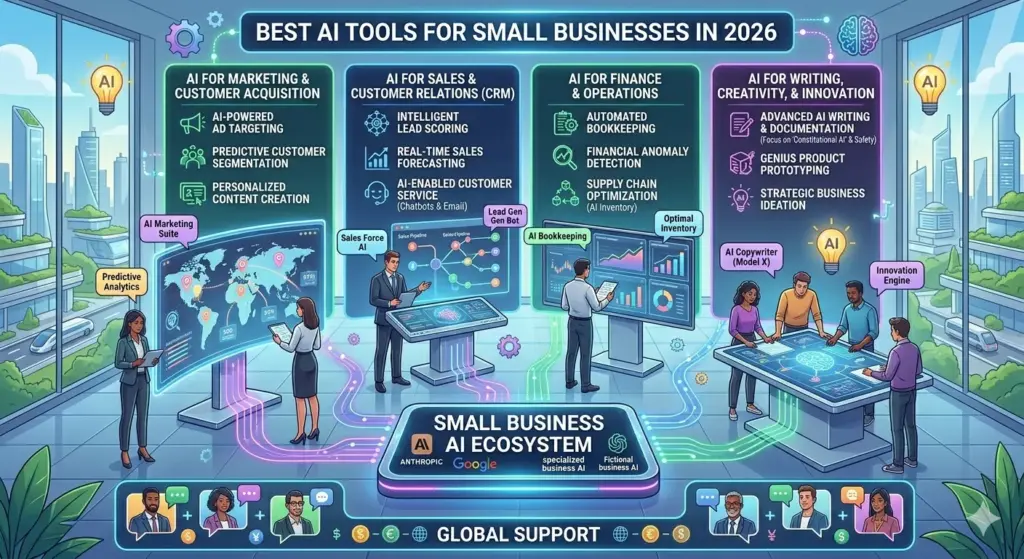
A lot of startups now rely on AI tools for business tasks the same way they rely on accounting apps or cloud storage. If you follow platforms like atechnewsdaily.com, you have probably noticed how quickly artificial intelligence software keeps showing up in daily workflows instead of staying limited to tech companies.
Table of Contents
Why AI tools for small businesses are becoming normal in 2026
The biggest change is that small business AI tools are no longer expensive or complicated to set up. A bakery owner can use AI marketing tools for Instagram captions. A freelancer can automate invoices. A small ecommerce store can run customer support AI without hiring a full support team.
Most people are using AI-powered tools quietly in the background now. The software writes summaries, sorts emails, answers basic customer questions, schedules social media posts, and helps with workflow automation. None of it feels futuristic anymore. It just feels practical. Also Read: How to Transfer Data from old Iphone to New Iphone? Complete Guide
Another thing worth noticing is how many AI business solutions are built for non-technical users. You do not need coding knowledge to use machine learning tools now. Most platforms work with templates, drag-and-drop automation, or simple prompts.
There is also a growing difference between tools that actually help and tools that only look impressive in ads. People are getting more selective. Business owners want small business automation that saves real time, not another dashboard to manage.
A quick comparison of popular AI business platforms
| Tool | Best Use Case | Starting Point | Good For |
| ChatGPT | Writing, brainstorming, support replies | Free/Paid | AI content generation |
| Claude | Long-form writing and analysis | Paid | Documentation and planning |
| Gemini | Google workspace integration | Free/Paid | Productivity workflows |
| Notion AI | Notes and team organization | Paid | Workflow automation |
| Jasper | Marketing copy | Paid | AI marketing tools |
| HubSpot AI | CRM and automation | Paid | Customer management |
| Zapier AI | App connections | Paid | Business automation tools |
| Canva AI | Graphics and visual content | Free/Paid | Social media content |
A lot of people compare language models before picking one. Articles like claude vs gemini vs chatgpt which one is better? have become common because users want to know which assistant actually fits their workflow instead of chasing hype.
ChatGPT still sits at the center of many workflows
OpenAI created something that became part search engine, part writing assistant, and part brainstorming partner for many small teams. ChatGPT is still one of the most flexible AI productivity tools available.
People use it for:
- Writing emails
- Drafting blog posts
- Customer response templates
- Product descriptions
- Meeting summaries
- FAQ generation
- AI chatbot tools integration
The reason it keeps growing is flexibility. Some AI software for startups focuses on only one task. ChatGPT works across many areas without forcing a business into one workflow.
It also helps with AI content generation without requiring advanced training. Small businesses that cannot afford large marketing teams often rely on it for early-stage content work. Also Read: How to use Notion AI to organize your entire life?
Claude works well for long documents and calm writing
Anthropic built Claude with a different feel compared to other assistants. It tends to handle large documents better and often sounds less mechanical in long writing tasks.
Writers, consultants, and research-heavy businesses use it for:
| Common Claude Usage | Why Businesses Like It |
| Proposal writing | Handles long context well |
| Policy documents | Better formatting consistency |
| Research summaries | Easier reading flow |
| Team documentation | Cleaner structure |
For companies managing internal documentation, customer onboarding guides, or research notes, Claude feels less rushed than some competing artificial intelligence software.
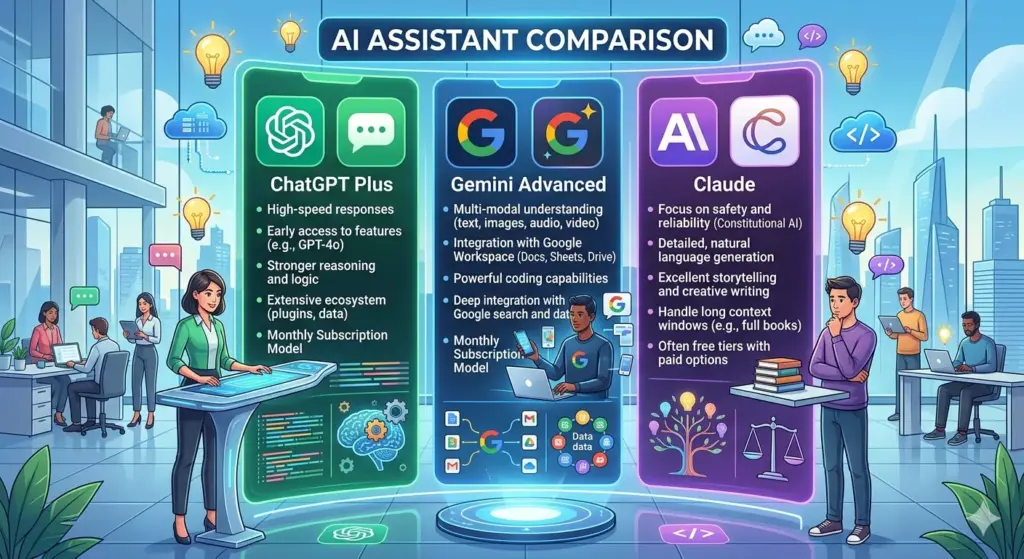
Gemini fits businesses already using Google products
Google pushed Gemini deeply into Gmail, Docs, Sheets, and other workspace products. That matters because many small companies already operate inside Google’s ecosystem.
Instead of switching between apps constantly, teams can use AI-powered tools directly where they already work.
Gemini is often useful for:
- Email drafting
- Spreadsheet analysis
- Meeting note summaries
- Calendar planning
- Internal collaboration
This is one reason small business AI tools are spreading faster now. Businesses do not always need separate software anymore. AI gets added into tools they already pay for.
AI marketing tools are replacing repetitive content work
Marketing is one area where businesses noticed time savings quickly. Writing captions, ad copy, product descriptions, and newsletters every week drains energy from small teams.
Platforms likeJasper,Copy.ai, and Writesonic became popular because they reduce repetitive writing tasks.
These AI marketing tools are commonly used for:
| Marketing Task | AI Assistance |
| Blog outlines | Faster planning |
| Facebook ads | Multiple variations |
| SEO descriptions | Quick drafting |
| Email campaigns | Subject line testing |
| Social captions | Faster publishing |
The quality still depends on editing. Businesses that publish raw AI text without reviewing it usually sound generic. The better approach is using AI for first drafts while humans shape the final version.
That balance matters more in 2026 because readers notice over-automated writing faster now.
Customer support AI became more useful than expected
A few years ago, many chatbot systems felt frustrating. They repeated scripted answers and confused customers. That changed quite a bit. Modern customer support AI can handle order tracking, refund requests, appointment scheduling, and basic troubleshooting without sounding completely robotic.
Platforms like Intercom andZendesk AI are being used by online stores, agencies, and service businesses that cannot manage 24-hour support teams.
This shift matters because AI customer service software for small businesses in 2026 is less about replacing staff and more about reducing overload. A support agent dealing with 300 repetitive tickets weekly can focus on difficult customer cases instead. Also Read: How to Connect Bluetooth Device to any TV? Complete Guide
Automation tools quietly save the most time
People usually talk about flashy AI content generation, but the biggest time savings often come from invisible automation.
Zapier AI andMake connect apps together so repetitive work happens automatically.
Examples include:
- Saving email attachments to cloud storage
- Sending invoice reminders
- Posting scheduled content
- Updating CRM records
- Moving leads into spreadsheets
- Assigning customer tickets automatically
This type of small business automation reduces manual work without forcing teams to change how they already operate.
Many owners searching for “how AI tools help small businesses automate daily tasks” are usually looking for this kind of practical automation instead of advanced robotics or complicated machine learning tools.
Canva AI made design work less intimidating
Canva keeps becoming more useful for small brands that cannot hire full-time designers.
Its AI features help with:
| Canva AI Feature | Typical Use |
| Magic Resize | Social media formatting |
| AI image generation | Quick visual concepts |
| Background removal | Product images |
| AI text suggestions | Captions and headlines |
This is especially useful for restaurants, ecommerce stores, coaches, and local businesses trying to maintain social media consistency without spending hours designing posts.
Among the best AI tools for social media management and scheduling, Canva still remains one of the easiest starting points. Also Read: Best AI tools for small businesses in 2026
CRM software is changing with AI integration
Customer relationship software used to feel heavy and complicated for smaller companies. Modern AI business solutions simplified many of those systems.
HubSpot AI and Salesforce Einstein now include automation for lead scoring, email drafting, customer summaries, and analytics.
Businesses use these tools to:
- Track leads automatically
- Generate follow-up emails
- Predict customer behavior
- Organize sales pipelines
- Analyze conversion trends
The rise of AI-powered CRM software for startups and growing businesses shows how AI keeps moving into normal operations instead of staying limited to content creation.
Accounting and bookkeeping tools are becoming smarter
Financial admin work drains time from small teams faster than most people admit.
Tools like QuickBooks AI and Xero now automate parts of bookkeeping, invoice categorization, and expense tracking.
For entrepreneurs managing limited staff, top AI accounting and bookkeeping tools for entrepreneurs can reduce hours of repetitive work every month.
That matters because business efficiency tools are often more valuable when they remove boring admin tasks instead of creating fancy reports nobody reads.
Choosing the right tool matters more than using many tools
A mistake many businesses make is signing up for too many platforms at once.
Using five disconnected business automation tools usually creates confusion instead of productivity. Small teams work better when they choose software that fits existing habits.
Here are a few practical questions businesses ask before subscribing:
| Question | Why It Matters |
| Does this save time weekly? | Real usefulness |
| Can non-technical staff use it? | Easier adoption |
| Does it integrate with existing apps? | Less friction |
| Is the pricing sustainable? | Long-term use |
| Does it remove repetitive work? | Better efficiency |
People searching “how to choose the right AI software for a small business” are usually trying to avoid tool overload more than anything else.
Some tools feel temporary while others become part of daily work
The AI industry moves fast, and many products disappear after a year. Some platforms survive because they become genuinely useful inside everyday business operations. That is probably why the best SaaS tools 2026 discussions keep focusing on workflow integration instead of flashy demos.
Businesses tend to keep software that:
- Saves time consistently
- Requires little training
- Works with existing systems
- Reduces repetitive tasks
- Helps smaller teams compete
The interesting thing is that AI for entrepreneurs is becoming less about experimentation and more about operational survival. Small businesses are expected to move faster now. Customers expect quicker responses, regular content, faster support, and smoother communication. Without some level of automation, small teams fall behind pretty quickly. Also Read: Best Vpns for the US in 2026? Complete Guide
Final thoughts
The most useful AI tools for business work are not always the most advanced ones. Usually, they are the ones employees keep opening every day because they quietly remove friction from work. Some businesses rely heavily on AI chatbot tools. Others mainly use workflow automation or AI marketing tools. There is no single setup that fits everyone.
What changed in 2026 is that artificial intelligence software stopped feeling experimental for smaller companies. It became part of ordinary work routines. Businesses use it to save time, stay organized, and keep up with growing workloads without constantly hiring more staff.
That shift will probably continue as AI software for startups becomes cheaper, easier to use, and more connected with the apps people already depend on every day.