
Both are AI. Both are built by some of the most well-funded technology companies on the planet. Both are changing how people interact with the world around them. But how does ChatGPT differ from Waymo AI is one of those questions where the surface-level answer “one is a chatbot and one drives cars” barely scratches what’s actually different between them.
The underlying technology, the data they process, the problems they’re solving, and the risks they carry are fundamentally different in ways that matter if you want to understand where AI is actually headed Here’s the full comparison. Also Read Why Are Companies Investing Billions in AI Infrastructure?
Table of Contents
What ChatGPT Is and What It Actually Does
ChatGPT is a large language model (LLM) built by OpenAI. It processes text — and increasingly images, audio, and documents and generates responses based on patterns learned from an enormous dataset of human-written content.
When you type something into ChatGPT, the model predicts what the most useful, coherent, contextually relevant response would be. It doesn’t look things up in real time by default. It doesn’t know what happened yesterday unless you tell it or unless it’s been given a web search tool. It generates output based on statistical relationships between words, ideas, and concepts absorbed during training.
The use cases are broad: writing assistance, coding, research, summarization, brainstorming, customer service, education, data analysis, and increasingly, agentic tasks where it operates tools and workflows autonomously.
As of 2026, more than 400 million people use ChatGPT weekly. It runs on OpenAI’s cloud infrastructure, accessed through a browser, mobile app, or API. The output is text, code, images, or structured data — delivered back to the user in seconds.
What Waymo AI Is and What It Actually Does
Waymo is an autonomous vehicle company, a subsidiary of Alphabet — Google’s parent company. Its AI doesn’t process conversation or generate text. It processes the physical world in real time and makes split-second decisions about how to operate a vehicle safely.
Understanding how does ChatGPT differ from Waymo AI becomes clearer when you look at what Waymo’s system actually ingests: input from cameras, lidar sensors, radar, and GPS — all simultaneously, continuously, dozens of times per second. The AI fuses that sensor data to build a three-dimensional model of everything around the vehicle — pedestrians, cyclists, other cars, road signs, construction zones, unexpected obstacles — and decides in real time how the vehicle should move.
As of June 2026, Waymo operates commercial robotaxi services in 10 US metropolitan areas including San Francisco, Phoenix, Los Angeles, Austin, Atlanta, and expanding cities. It has 3,871 robotaxis in active service, provides 500,000 paid rides per week, and has logged 200 million fully autonomous miles on public roads. Before that, it practiced 20 billion miles in simulation — virtual environments that let the AI encounter rare and dangerous scenarios without real-world consequences.
In 2026, Waymo introduced the Waymo World Model a frontier generative model for large-scale, hyper-realistic autonomous driving simulation and transitioned from rule-based algorithms to fully generative neural networks for predictive behavioral modeling. Its 6th-generation hardware integrates high-resolution imaging radar, next-generation solid-state lidar, and overlapping computer vision cameras that dynamically cross-verify each other in milliseconds.

How Does ChatGPT Differ from Waymo AI — The Core Differences
This is the heart of it. The two systems are both AI, but they’re solving fundamentally different problems using fundamentally different approaches.
Input type: ChatGPT processes language — text, images, audio, documents. Everything it understands arrives as data it interprets through trained representations of meaning.
Waymo processes the physical environment in real time — lidar point clouds, radar signals, camera feeds, GPS coordinates, HD map data. The inputs are continuous streams of sensory information from the world around a moving vehicle.
Output type: ChatGPT generates language — responses, code, summaries, structured data. The output exists in a digital space.
Waymo generates physical actions — steering angle, acceleration, braking, lane changes. The output exists in the real world, with real-world consequences that are immediate and irreversible.
Speed of operation: ChatGPT processes a query and returns a response in a few seconds. The pace is conversational.
Waymo’s AI makes decisions dozens of times per second while the vehicle is in motion. A pedestrian stepping off a curb requires a response in milliseconds. Speed is existential — a delayed decision at 40 mph has physical consequences.
Consequences of error: ChatGPT giving a wrong answer is a problem. It can mislead someone, produce incorrect code, or give bad advice. But the person reading the output can pause, evaluate, and push back.
Waymo making an error in real-time perception or decision-making can mean a collision. The stakes of failure are physical harm — which is why Waymo’s safety testing involves thousands of crash avoidance scenarios and billions of simulated miles before public deployment.
Memory and context: ChatGPT operates primarily within a session window, with optional memory features for persistent personalization across sessions. The context it carries is conversational.
Waymo maintains continuous spatial awareness of a changing environment — updating its model of the world multiple times per second as the vehicle moves, conditions change, and other actors in the environment behave unpredictably.
Who controls the output: ChatGPT’s output is reviewed and acted on by a human. You read the response, decide if it’s right, and choose what to do with it.
Waymo’s output is the vehicle’s movement. There is no human in the loop reviewing the AI’s decision before it executes. The AI acts directly. This is what Level 4 autonomy means — no human driver required within its operational domain. Also Read How to use Notion AI to organize your entire life?
The Technology Stack — Side by Side
Understanding how does ChatGPT differ from Waymo AI at the technical level makes the difference even sharper.
| Dimension | ChatGPT | Waymo AI |
|---|---|---|
| Core technology | Large Language Model (LLM) | Computer vision, lidar processing, sensor fusion, neural networks |
| Input | Text, images, audio, documents | Camera, lidar, radar, GPS, HD maps |
| Output | Text, code, images, structured data | Vehicle control commands (steering, braking, acceleration) |
| Processing speed | Seconds per response | Milliseconds per decision cycle |
| Operating environment | Digital (cloud-based) | Physical world, public roads |
| Autonomy level | Responds to human prompts | Level 4 autonomous — no human driver |
| Consequences of failure | Bad information, incorrect output | Physical collision, injury risk |
| Training data | Internet text, books, code, images | Road miles, sensor data, simulation scenarios |
| Deployment | Browser, mobile app, API | Embedded in vehicle hardware |
| Parent company | OpenAI (Microsoft-backed) | Alphabet (Google parent) |
Different Problems, Different Design Philosophies
The question of how does ChatGPT differ from Waymo AI also comes down to what each system was designed to optimize for.
ChatGPT is optimized for usefulness across an enormous range of tasks. The model needs to be helpful, accurate, harmless, and honest across millions of different contexts from creative writing to coding to medical questions. It can’t be precisely right all the time on every topic, so it’s designed to be cautious about uncertainty, acknowledge limitations, and let humans make the final judgment.
Waymo is optimized for one very specific task driving safely Executed with near-perfect consistency. There’s no room for the model to say “I’m not sure, you should probably check this.” The car either navigates the intersection correctly or it doesn’t. This is why Waymo has spent 17 years and billions of dollars in testing before scaling commercially — the bar for acceptable failure rates is dramatically higher than any conversational AI.
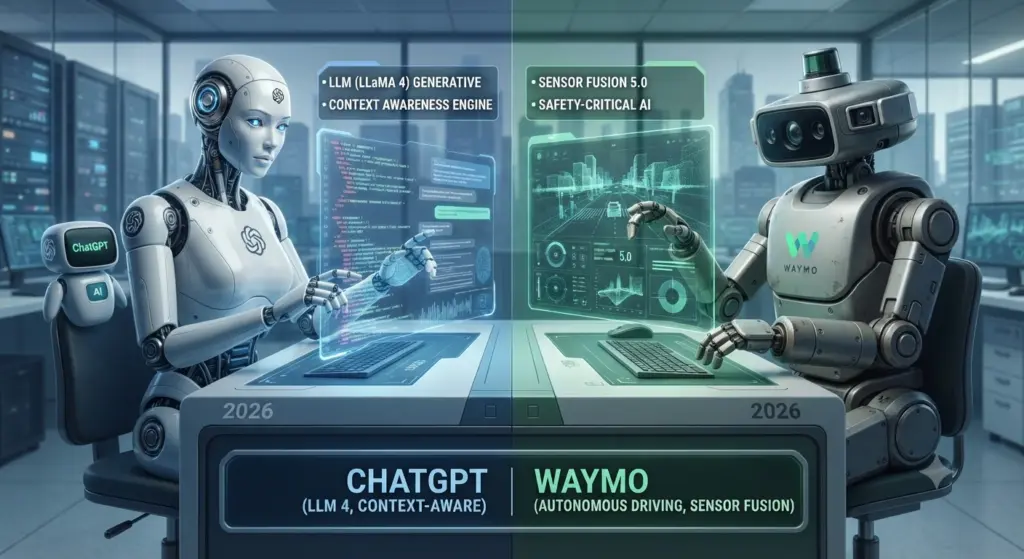
This reflects a broader distinction in AI design: general-purpose AI systems like ChatGPT trade precision for versatility, while specialized AI systems like Waymo trade versatility for precision in a narrow, high-stakes domain.
How Does ChatGPT Differ from Waymo AI in Terms of Risk?
Both carry real risks but different kinds.
ChatGPT’s risks are primarily informational — spreading misinformation, producing biased outputs, generating harmful content if not properly constrained, and enabling academic dishonesty or fraud. These risks scale with the number of people using the tool and the trust they place in its outputs.
Waymo’s risks are primarily physical — sensor failure, edge case scenarios the AI wasn’t trained on, adversarial road conditions, and the cascading consequences of an error that occurs at highway speed. A ChatGPT mistake can be corrected with a follow-up message. A Waymo mistake can’t be undone.
This is also why their regulatory environments are different. ChatGPT is largely unregulated at the federal level in the US in 2026, with some sector-specific restrictions. Waymo operates under state DMV regulations, National Highway Traffic Safety Administration oversight, and must obtain specific permits to operate autonomously in each jurisdiction. As of November 2025, Waymo has DMV permission to drive autonomously across the entire nine-county San Francisco Bay Area plus Sacramento and Yolo counties, and across a wide stretch of Southern California but each expansion requires regulatory approval. Also Read Best AI tools for small businesses in 2026
What They Have in Common — More Than You’d Think
Even though how does ChatGPT differ from Waymo AI is a question with many clear answers, the two systems share more architectural DNA than their surface applications suggest.
Both use deep neural networks trained on massive datasets. Both rely on transformer-based architectures — Waymo’s World Model introduced in February 2026 is explicitly a generative model that shares conceptual foundations with the models powering ChatGPT. Both involve AI systems predicting what should happen next based on patterns in training data. And in 2026, Waymo actually uses language models internally — for processing voice commands from passengers, for natural language interfaces in its operations, and for interpreting certain categories of road signage and text.
The convergence is real. OpenAI’s research increasingly touches physical-world reasoning. Waymo’s research increasingly touches the kind of generative modeling that LLMs pioneered. The boundary between language AI and physical-world AI is blurring in research — even as the deployed products remain very different in what they do and how they’re used.
Could ChatGPT Ever Power a Self-Driving Car?
This question naturally follows any discussion of how does ChatGPT differ from Waymo AI — if both are AI, couldn’t one do the other’s job?
Not in its current form and not directly. ChatGPT is optimized for language understanding and generation — it isn’t designed to process lidar point clouds or make millisecond physical control decisions. The latency alone would be disqualifying. ChatGPT generating a response in one to three seconds is fine for conversation. In an autonomous vehicle, one to three seconds of delay is 60 to 180 feet of travel at highway speed.
That said, the underlying research trajectories are converging. Vision-language models that can understand both physical scenes and natural language are advancing rapidly. OpenAI’s work on robotics — and its investment in companies building physical AI systems — suggests that the architecture gap between language models and physical-world models is narrowing. The question isn’t whether language models can ever power physical systems. It’s about whether they can meet the reliability, latency, and safety requirements that physical systems demand. In 2026, that gap remains significant.
The Bottom Line — How Does ChatGPT Differ from Waymo AI?
The clearest summary: ChatGPT processes meaning. Waymo processes the physical world.
ChatGPT takes human language in and produces human language out — working in the domain of information, ideas, and communication.
Waymo takes sensor data about a physical environment in and produces vehicle control commands out — working in the domain of space, physics, and real-time safety.
How does ChatGPT differ from Waymo AI in terms of what matters most about each one? ChatGPT’s value is in being useful to as many people as possible across as many tasks as possible. Waymo’s value is in being reliably safe in one specific, extremely high-stakes task — getting a passenger from point A to point B without incident.
Both are genuinely impressive achievements in AI. Both are commercial deployments at meaningful scale. But calling them the same kind of thing because both use neural networks is like calling a stethoscope and a chainsaw the same kind of tool because both have moving parts.
Same foundational technology. Completely different applications. Completely different design constraints. And in 2026, both of them changing their respective corners of the world in ways that would have seemed implausible just five years ago. Also Read How Modular Data Centers Solve AI’s Infrastructure Problem