With OpenAI alone reporting over 200 million weekly active users across ChatGPT and its API, and Anthropic, Google, and dozens of open-source providers offering high-quality text generation at consumer prices, the question of how to detect AI-written content has gone from a niche academic concern to a daily problem for teachers, editors, hiring managers, and publishers. Lets uncover How to Detect AI-Written Content?
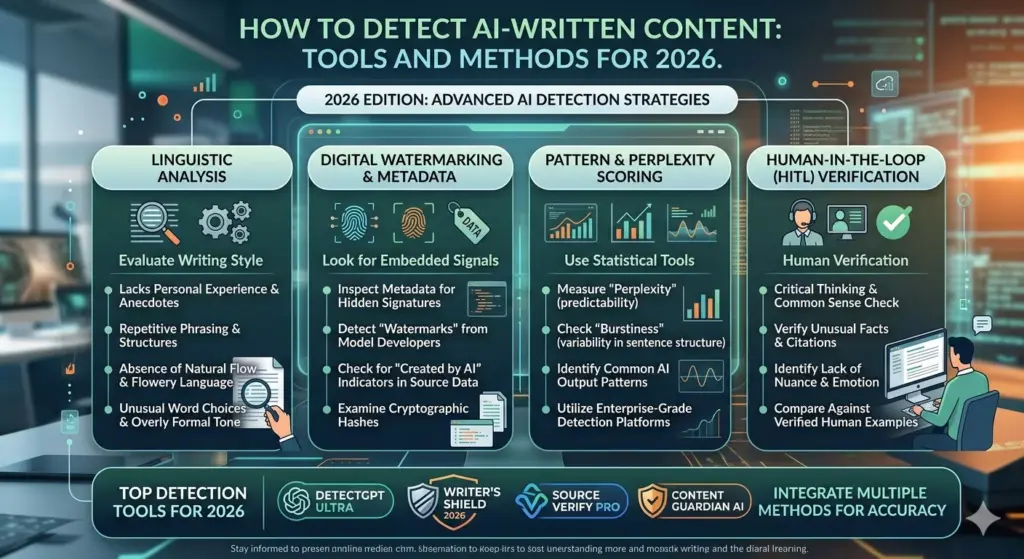
The uncomfortable truth heading into the second half of 2026: there is no single tool or trick that solves this reliably. What exists instead is a toolkit of imperfect methods that, used together, get you a reasonably confident answer just not a certain one.
Table of Contents
The Short Answer: No Detector Is Perfect, But Combinations Work Better
Independent benchmarking gives a useful reality check before relying on any single method. Testing across recent flagship models found that even leading detection tools miss somewhere between 15% and 30% of AI-generated text, and false-positive rates human writing incorrectly flagged as AI typically range from 3% to 12% on paid tools and considerably higher on free ones. Separate academic research, including work from the University of Chicago, has found detection accuracy drops sharply on short passages, particularly text under roughly 50 words. That single fact explains why detecting AI in a 2,000-word essay is a fundamentally different problem than detecting it in a resume bullet point or a one-paragraph email. Also Read: How to check phone is original or fake?
With that ceiling in mind, here are the four real categories of methods people actually use in 2026, roughly in order of how mature and reliable they currently are.
Method 1: Dedicated AI Detection Tools
Software detectors remain the most common starting point. They generally combine two technical signals: perplexity (how predictable each word choice is, statistically, given the words before it) and burstiness (how much sentence length and structure vary across a passage). Human writing tends to be less predictable and more uneven; AI output tends to be smoother and more statistically average. Modern detectors layer a trained classifier model on top of these signals, continuously retrained on fresh samples from current AI models.
The tools most commonly cited in 2026 testing include GPTZero, Originality.ai, Copyleaks, Turnitin, Winston AI, Sapling, Pangram Labs, ZeroGPT, and QuillBot. Each has a different niche: Turnitin and Copyleaks are built around education and integrate with learning management systems like Canvas and Blackboard; Originality.ai pairs AI detection with plagiarism and fact-checking for content and SEO teams; Pangram Labs and Winston AI emphasize accuracy on long-form content and bulk scanning; GPTZero offers a “Writing Replay” feature that shows the drafting history of a document as supplementary evidence rather than relying on a score alone.
Vendor-reported accuracy claims should be treated skeptically, because they vary enormously depending on who’s measuring. On the academic RAID benchmark, for instance, independent researchers have reported Originality.ai scoring around 96–97% on paraphrased AI text, while results for other popular tools have ranged much lower on the same benchmark sometimes by 30 percentage points or more depending on which AI model produced the text and how heavily it was edited. Also Read: How to Recover Deleted Photos on iphone and Android?
Cornell University researchers have separately ranked Copyleaks among the stronger performers for general LLM text detection, and Penn State’s AI research lab has been cited in validating GPTZero’s claims. The practical lesson is that no detector should be treated as a verdict; treat the output as a probability score, run more than one tool on anything high-stakes, and weight independently benchmarked results over a vendor’s own marketing claims.
It’s also worth knowing where detectors are weakest: short-form and formulaic text (resumes, bios, bullet-pointed lists) tends to produce both false positives and false negatives, because that kind of writing is naturally repetitive and “statistically bland” even when a human wrote it. Detectors also disproportionately flag the writing of non-native English speakers and technical authors, whose more formal, rule-following prose can resemble AI output by coincidence — a known fairness problem that hasn’t been fully solved by any vendor as of 2026.
Method 2: Provenance and Watermarking
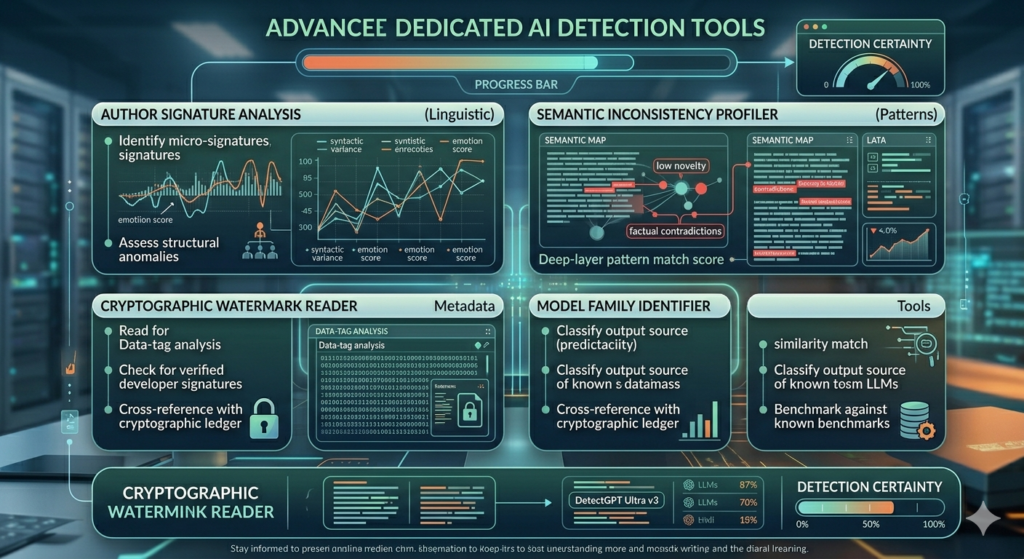
The structural alternative to guessing from the text itself is to check whether the content was labeled as AI-generated at the moment of creation. This is where the industry has made its most concrete progress in 2026, even though it remains far from universal.
The Coalition for Content Provenance and Authenticity (C2PA) backed by Google, Microsoft, Adobe, Meta, OpenAI, Sony, the BBC, and thousands of other members embeds cryptographically signed metadata into files describing how they were created or edited. Adobe has built this directly into Photoshop, Lightroom, and Firefly; Microsoft began adding C2PA metadata to Microsoft 365 content in early 2026.
Running alongside this is Google DeepMind’s SynthID, an invisible watermark embedded directly into the pixels of an image, the waveform of audio, or frames of video, designed to survive cropping, compression, and resizing in ways that metadata alone cannot. Google reports SynthID has now been used to label over 100 billion pieces of content, and in May 2026 OpenAI agreed to apply SynthID watermarking to images generated through ChatGPT, Codex, and its API, alongside previewing a public verification tool that checks uploaded images for both signals at once.
The catch is significant: this infrastructure is currently far more mature for images, audio, and video than for plain text, and it only works for content generated by participating tools. OpenAI’s own verification tool, for example, currently checks only images produced by its own products it has no way to assess content from the much larger ecosystem of AI tools that haven’t adopted these standards. Metadata can also be stripped by re-saving or reformatting a file, and several major coordinating bodies, including Microsoft’s own integrity researchers, have acknowledged that no single provenance method can catch every case. Also Read: How to Speed Up a Slow Android Phone in 2026
For text specifically, watermarking exists in limited form (Google has applied SynthID to Gemini-generated text), but it isn’t yet a practical, widely checkable solution the way image watermarking is becoming.
Method 3: Manual, Stylistic Detection
Long before software detectors existed, careful readers were already spotting AI text by ear, and this skill remains genuinely useful — arguably more useful than people expect, since it doesn’t depend on any tool’s training data being up to date.
Vocabulary is the most discussed tell. AI models, trained heavily on formal and academic text, lean on words like delve, underscore, leverage, robust, tapestry, realm, beacon, and testament far more often than typical human writing does.
Researchers studying this phenomenon have even found that different AI models have distinguishable vocabulary fingerprints, sometimes called “aidiolects” though these patterns shift over time as AI companies notice and patch them out. The word “delve,” for instance, was so overused by ChatGPT through 2023 and early 2024 that its frequency became a running joke before dropping sharply in 2025 as OpenAI adjusted the model.
Structural tells matter as much as word choice. AI-generated prose often follows a metronome-like rhythm — sentences clustering in a narrow 12-to-18-word range, formulaic transitions like “moreover,” “furthermore,” and “in conclusion” doing the connective work that a human writer would more often skip, and a reflexive tendency to organize ideas into tidy groups of three.
Typographic quirks can add weak supporting evidence too: large language models tend to overuse em dashes in places a human would more naturally use a comma or colon, and chatbots like ChatGPT and DeepSeek default to curly quotation marks — though this last signal is weak on its own, since word processors like Microsoft Word and macOS auto-convert straight quotes into curly ones by default.
Content-level signs round out the picture: an absence of specific personal anecdotes or concrete lived detail, an oddly even-handed tone that hedges every claim, and counter intuitively confidently stated but factually wrong details, since AI models can produce fluent text about things they’ve gotten wrong. None of these signs is conclusive in isolation. The strongest manual read combines several at once: a paragraph with three “delve”-style words, uniform sentence rhythm, and zero specific personal detail is a much stronger signal than any single tell by itself.
The Cat-and-Mouse Problem
Whatever method you choose, it’s worth knowing that an entire counter-industry now exists specifically to defeat detection. “Humanizer” tools rewrite AI output to disrupt the statistical patterns detectors look for, and obvious vocabulary tells get scrubbed out by writers (human or AI-assisted) who’ve simply read one of the many “AI words to avoid” lists now circulating.
Detection tool accuracy drops substantially against heavily paraphrased or humanized text; only a handful of tools, Pangram Labs and Originality.ai among the most cited in independent testing, have demonstrated meaningfully better resilience against this kind of evasion. This dynamic is exactly why provenance and watermarking are increasingly described as the more durable long-term fix a watermark embedded at generation time survives editing in a way that after-the-fact statistical detection cannot guarantee.
Matching the Method to the Stakes
Which approach makes sense depends heavily on why you’re checking in the first place. For academic integrity, pairing a detector score with process evidence document version history, a platform like GPTZero’s drafting replay, or a require-and-review workflow is far more defensible than a bare percentage, especially given how often false positives disproportionately affect non-native English speakers. Also Read: How to use Notion AI to organize your entire life?
For SEO and content marketing, it’s worth knowing that Google has stated repeatedly that it evaluates content quality and usefulness rather than penalizing content simply for being AI-assisted, which means chasing a “passes the detector” outcome is often less valuable than focusing on accuracy, originality, and demonstrated expertise. For hiring and resume screening, detectors are at their least reliable on exactly the kind of short, formulaic text resumes are made of, so treat any AI-detection signal there as a loose hint rather than a basis for rejecting a candidate.
And for publishers, brands, or anyone dealing in images, audio, or video specifically, checking for C2PA credentials or a SynthID watermark is becoming the more defensible form of proof, precisely because it doesn’t rely on guessing from style alone.
The Bottom Line
Detecting AI-written content in 2026 is best understood as triangulation rather than a single test. Software detectors give you a probabilistic signal that’s strongest on long-form text and weakest on short or heavily edited passages. Provenance and watermarking offer something closer to real proof, but only for content generated by participating tools, and mostly for images, audio, and video rather than plain text so far.
Manual stylistic reading remains genuinely useful and improves the more text you read, but it’s a moving target as AI providers quietly patch out the most obvious tells. None of these methods alone should be treated as definitive, especially in situations academic discipline, hiring, journalism where being wrong carries real consequences for the person on the other end of that judgment.