
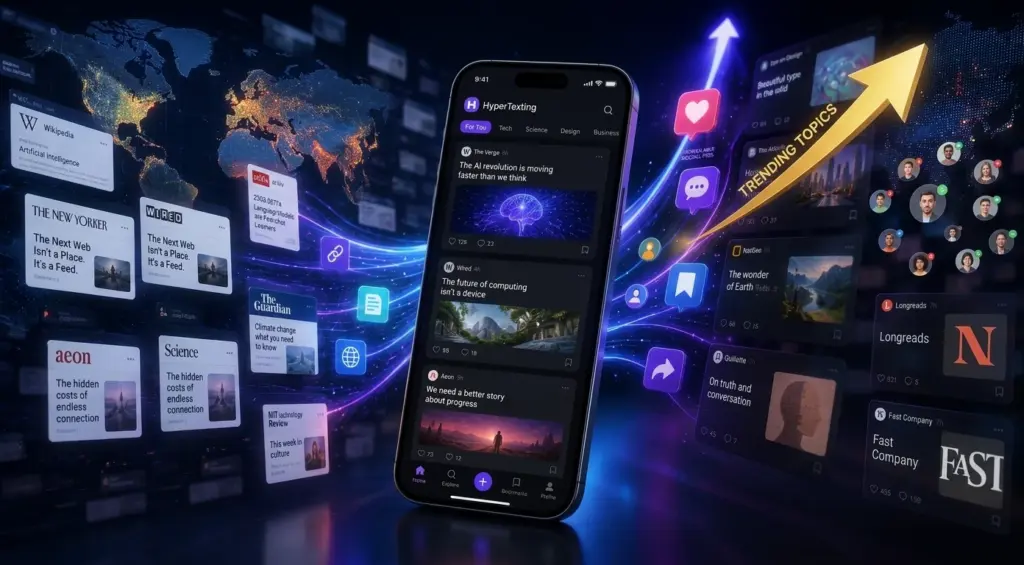
There’s a new app on the block trying to answer a question a lot of us have quietly been asking for years. What if the open web could feel as easy to browse as Instagram or X, without an algorithm deciding what we see?
That’s the whole premise behind HyperTexting, an iPhone app that launched on the App Store in late June. It’s been picking up attention since TechCrunch covered it earlier this month.
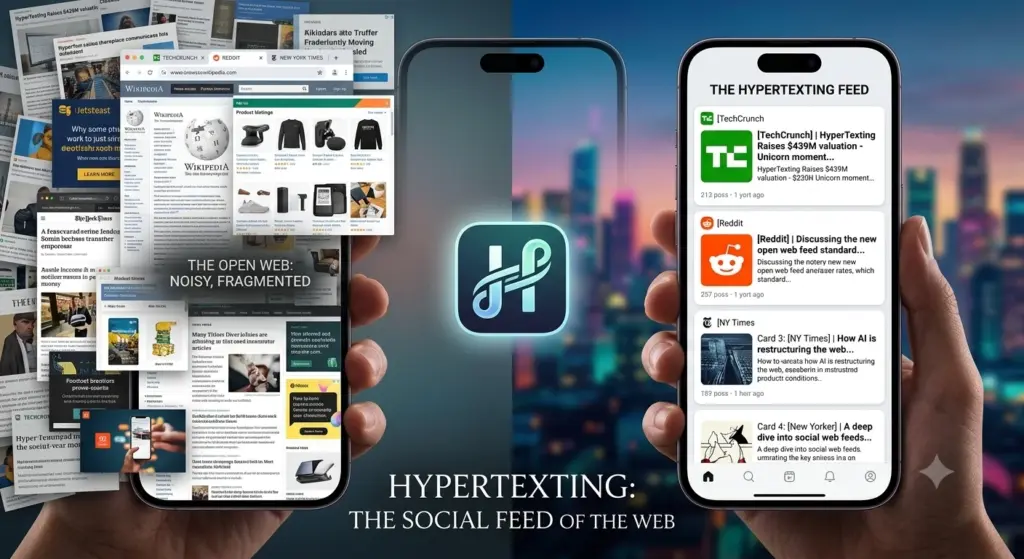
The pitch is refreshingly simple. HyperTexting turn open web into scrollable social media the same way apps like Twitter and Facebook once did. Except everything you see actually comes from the sites, blogs, and newsletters you chose to follow, not from a black box optimizing for your attention. Also Read How Is Agentic AI Different from Traditional Chatbots?
Table of Contents
What HyperTexting Actually Does
The app was built by Caleb Hailey, a twenty-year tech industry veteran who runs a small company called Herd Works. His frustration is a familiar one if you’ve spent any time online in the last decade.
Platforms that used to be great for discovering things Twitter, mainly slowly stopped showing you posts in the order they happened. They started showing you whatever kept you scrolling the longest instead. Hailey wanted something closer to the old internet, back when following a site meant actually seeing its updates, in order, without anything getting buried.
That’s exactly where HyperTexting turn open web into scrollable social media becomes more than a tagline. On the app, you follow people and websites the same way you’d follow an account anywhere else. News outlets, independent writers, podcasts, newsletters, whatever you’re into.
Once you’ve followed something, its updates start showing up in a single feed. It’s formatted with all the visual language we’ve all gotten used to: profile pages, a follow button, likes, comments. It looks and feels like social media. It just isn’t pulling content from a walled garden. Also Read How to Detect AI-Written Content: Tools and Methods for 2026
The RSS Engine Hiding Underneath
Here’s the part that’s almost funny, once you know it. HyperTexting is largely powered by RSS, a protocol that’s been quietly running under the hood of the internet since the early 2000s.
RSS never really went away. It still powers WordPress blogs and most podcast feeds today. But it never became something regular people used either. Apps like NetNewsWire and Feedly have offered RSS-based feeds for years, and they’re genuinely great tools. They were built for people who already understood what a feed was — journalists, researchers, obsessive readers. Not the average person scrolling their phone on the couch.
HyperTexting’s bet is that most people don’t actually want to manage a list of feeds. They just want to scroll something and stumble onto stuff they care about. So the app quietly does the RSS work in the background and never really mentions the word to its users.
What you get on the surface is exactly the thing Hailey set out to build. HyperTexting turn open web into scrollable social media without asking anyone to learn a new format first.
Posting Back to Your Own Site, Not a Platform
The other half of HyperTexting’s pitch is about publishing, not just reading. If you want to respond to something you saw in your feed, the app doesn’t let you post into some centralized comment section owned by HyperTexting.
Instead, it pushes you to publish on your own website. Whether that’s a WordPress blog, a Ghost newsletter, a Hugo-built site, or a page built with the company’s own tool, HyperTemplates. Your response then gets linked back to the original post and surfaces in the feeds of anyone else following that site.
It’s a small design choice, but it says a lot about the app’s philosophy. Rather than centralizing conversation the way social platforms do, HyperTexting turn open web into scrollable social media while quietly pushing ownership of that content back out to the individual sites where it was written. You keep the page. The app is just the window you’re viewing it through. Also Read How Modular Data Centers Solve AI’s Infrastructure Problem
Discovery Without an Algorithm
A fair question is what happens when you don’t already know what to follow. HyperTexting handles that with an Explore tab that surfaces content trending across the sites people are already following on the app.
It’s a rough echo of Nuzzel, the old link-curation tool that used to surface what was being talked about on Twitter before it quietly disappeared. There’s also a Safari extension that lets you add a site to your feed the moment you stumble across it while browsing. That solves the classic RSS-reader problem of following requiring too many manual steps.
Notably, the main feed itself stays reverse-chronological. No ranking model deciding what you probably want to see first. Just the newest post, at the top, from whoever you followed. It’s a small thing, but it’s also the thing a lot of people have been quietly missing since the timelines they grew up on stopped working that way.
Why This Matters Beyond One App
It’s easy to write this off as just another reader app with a fresh coat of paint, but the timing says otherwise. Most attempted fixes for algorithmic feeds have asked people to learn RSS readers or migrate to a whole new network like Mastodon or Bluesky.
HyperTexting turn open web into scrollable social media by skipping both asks no new network, no learning curve, just the existing web in a format people already know.
Also Read: How the First AI Run Ransomware Attack Still Needed a Human

Is HyperTexting Worth Trying?
Whether HyperTexting becomes the app that actually pulls this off remains to be seen. It’s iOS-only for now and free to download.
Its usefulness depends entirely on how many of your favorite corners of the internet still publish an RSS feed which, as it turns out, is more of them than you’d probably guess. As a proof of concept for how HyperTexting turn open web into scrollable social media, it’s one of the more interesting attempts to come along in a while.