
The AI infrastructure crisis is no longer a forecast it’s a headline. Nearly half of all U.S. data centers planned for 2026 have been canceled or delayed. Out of roughly 12 gigawatts of AI data center capacity announced for this year, only about 5 GW is under active construction. The rest sits stalled not for lack of investment, but for lack of power, permits, and community acceptance.
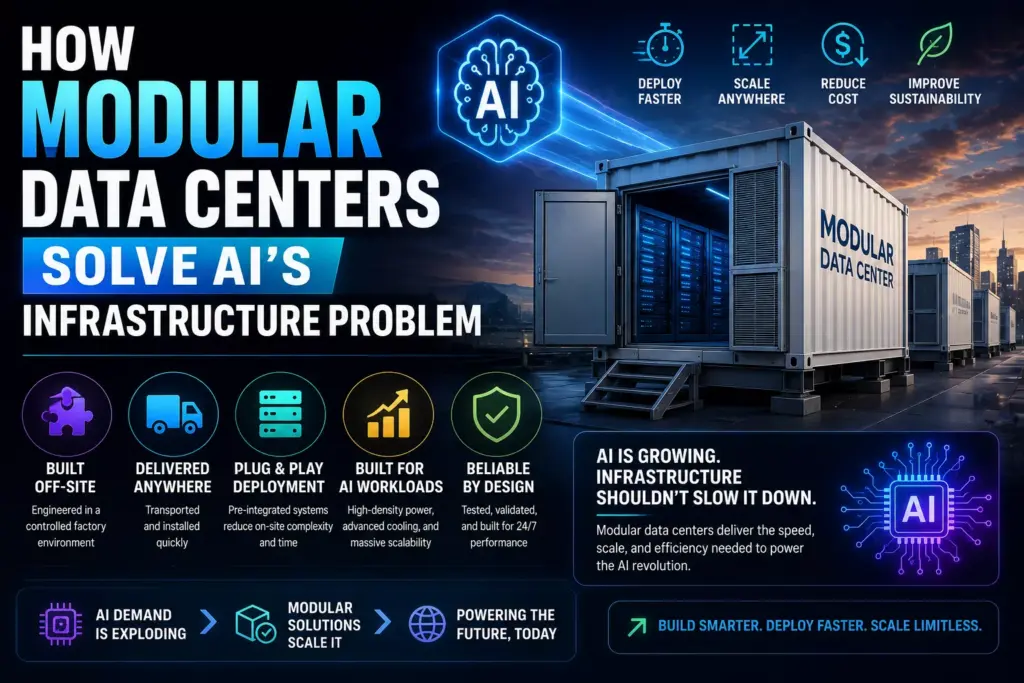
A growing number of analysts and operators now believe that modular data centers are the most practical path forward. Smaller, faster to deploy, lighter on local resources, and easier for communities to absorb, they represent a fundamentally different approach to a problem that conventional hyperscale construction has repeatedly failed to solve. This is the story of how data centers solve AI’s infrastructure problem not by building bigger, but by building smarter.
Table of Contents
AI’s Infrastructure Problem Is Getting Worse, Not Better
The scale of the challenge is difficult to overstate. As of early 2026, 190 gigawatts of hyperscale data center capacity has been announced across 777 projects globally. Global data center electricity consumption is projected to more than double by 2030. In the United States, data centers will soon consume more electricity than all energy-intensive manufacturing industries combined. Gartner estimates global data center electricity demand will exceed 1,000 TWh by 2026 more than the entire annual consumption of Japan.
The construction bottleneck is equally severe. While a data center building can be erected in 12 to 18 months, connecting it to the electrical grid now takes five to seven years in many U.S. regions. A single NVIDIA GB200 NVL72 rack draws 120 to 140 kilowatts a traditional enterprise data center built for 10 to 15 kW per rack cannot physically support these systems without a complete infrastructure overhaul. Transformers and switchgear, the unglamorous backbone of power delivery, are so backordered that transformer demand has increased 119% from 2019 to 2025 with manufacturing capacity far behind. Also Read: How to use Notion AI to organize your entire life?
The capital hasn’t flinched. Alphabet, Amazon, Meta, and Microsoft remain on track to collectively deploy more than $650 billion in 2026 on AI infrastructure. But money alone cannot fix a seven-year interconnection queue.
Why Hyperscale Is Struggling to Keep Pace
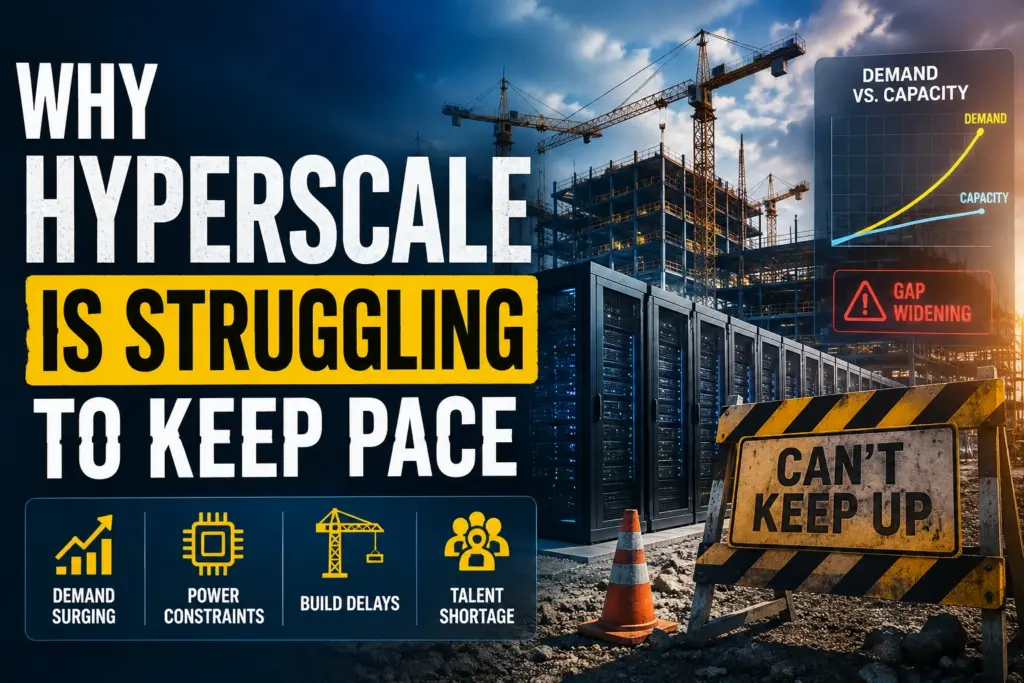
The traditional hyperscale data center model massive, centralized, grid-connected was built for a world where rack densities were measured in single-digit kilowatts and communities welcomed tech jobs. That world no longer exists.
Community opposition has become a genuine strategic headwind. In The Dalles, Oregon, Google’s data center expansion drew significant pushback over water consumption. In Illinois, organized opposition blocked a proposed facility in Pekin in 2026. In Arizona and Nevada, data center development is escalating conflicts with agricultural and residential water users against a backdrop of prolonged drought. State-level moratoria on new data center development are now a realistic risk in several markets, according to Ropes & Gray analysts tracking the sector.
The workforce problem compounds everything. As of late 2025, the construction industry faced a shortage of roughly 439,000 workers. Peak crew sizes for hyperscale data center construction have grown from around 750 workers during the cloud era to 4,000 to 5,000 today. The average age of the existing data center workforce is 53, and 60% of providers report difficulty filling open roles. Something in the model has to give. That something, increasingly, is the model itself.
What Modular Data Centers Actually Are
A modular data center is a prefabricated, self-contained computing facility often built into standardized enclosures resembling industrial shipping containers manufactured off-site in controlled factory environments, then shipped and deployed on location.
Unlike conventional facilities that must be designed, permitted, and constructed sequentially on a single site, modular units are built in parallel with site preparation. Power systems, cooling infrastructure, rack cabling, and network hardware are integrated and tested before delivery. Once on-site, a modular pod can be operational within days to weeks of arrival not months or years. Also Read: Grammarly vs QuillBot vs ChatGPT: best AI writing assistant?
IEEE Spectrum recently highlighted this model in practice: companies like Duos Edge AI and LG CNS are deploying purpose-built AI modular pods that sidestep the traditional construction pipeline entirely. Hewlett Packard Enterprise pioneered the concept with its AI “POD” standard 20- and 40-foot containers pre-configured with racks, cabling, power, and cooling that can support thousands of compute nodes in a portable footprint, ready to plug into existing power and networks within days of delivery.
The fundamental shift is this: modular infrastructure decouples computing capacity from the constraints of on-site construction. That single change cascades into every problem currently plaguing AI infrastructure deployment.
Speed: From Years to Months
The most immediate advantage is deployment speed, and the numbers are striking.
Traditional data centers require 24 to 36 months from groundbreaking to operation. Modular designs compress this to 8 to 12 months. As of December 2025, liquid-cooled AI modular deployments are achieving full operational readiness in 8 to 10 months including integrated direct-to-chip cooling for high-density GPU environments.
Edge computing company Vapor IO deployed 36 micro modular data centers across 20 U.S. cities in just 11 months, delivering GPU compute capacity three times faster than traditional construction at 40% lower cost. The approach standardized 150 kW factory-built modules that arrived on flatbed trucks and were operational within 72 hours of delivery. Also Read: Is AI Replacing Software Engineers? The Real Answer in 2026
At Data Center World 2026, Sean James, distinguished engineer for energy systems at Nvidia, described how the industry is relying on front-loaded design prefabrication and factory integration to reduce on-site work, and modular architectures that can be assembled quickly to deliver capacity faster while preserving flexibility as hardware requirements evolve. That model is already reshaping how hyperscalers think about deployment timelines.
Power: Bypassing the Grid Bottleneck
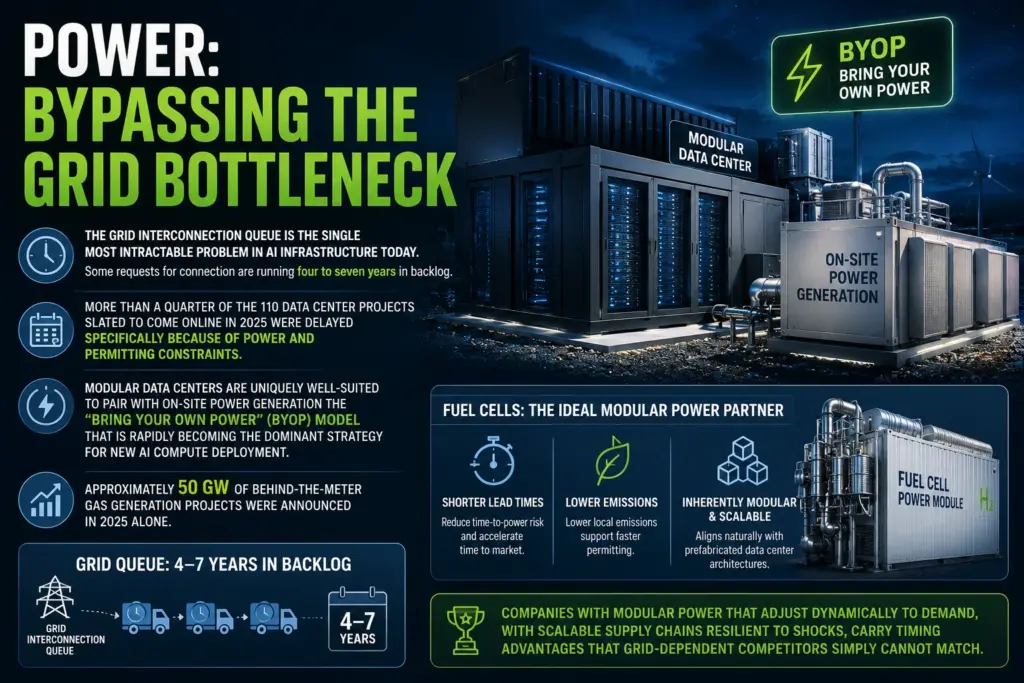
The grid interconnection queue is the single most intractable problem in AI infrastructure today. Some requests for connection are running four to seven years in backlog. More than a quarter of the 110 data center projects slated to come online in 2025 were delayed specifically because of power and permitting constraints.
Modular data centers are uniquely well-suited to pair with on-site power generation the “Bring Your Own Power” (BYOP) model that is rapidly becoming the dominant strategy for new AI compute deployment. Approximately 50 GW of behind-the-meter gas generation projects were announced in 2025 alone.
Fuel cells are emerging as a particularly attractive modular power pairing. They offer shorter lead times that reduce time-to-power risk, lower local emissions that support faster permitting, and inherent scalability and modularity that aligns naturally with prefabricated data center architectures. Companies producing modular power technologies that adjust dynamically to demand, with scalable supply chains resilient to shocks, carry timing advantages that grid-dependent competitors simply cannot match.
The result is a data center model that can site itself near available power rather than waiting years for available grid connections a fundamental reversal of how the industry has operated for 30 years.
Scale: Growing Capacity Without Starting Over
One of the most punishing financial realities of traditional data center construction is the binary nature of commitment. You build a facility sized for projected demand five years out, spend the capital, and wait. If demand exceeds expectations, you build again. If it falls short, you carry stranded assets.
Modular architecture solves this with pay-as-you-scale economics. Organizations begin with the capacity they need now one pod, two pods, a small cluster and add units incrementally as demand grows. No stranded capital. No overbuilding. No years-long planning cycles to add modest capacity expansions.
The modular data centers market is projected to grow by $69.27 billion at a compound annual growth rate of 22.4% from 2025 to 2030, according to Technavio a trajectory that reflects how powerfully this model aligns with the financial realities of AI infrastructure investment. Microsoft used prefabricated modules in its multi-billion-dollar Wisconsin data center expansion. Google deployed factory-built systems for rapid AI workload capacity in a $3 billion Virginia expansion. Amazon is expanding its own modular programs across its AI infrastructure portfolio. Also Read: Best AI tools for small businesses in 2026
McKinsey describes the broader industry shift: suppliers are now expected to deliver power, cooling, and control systems as pre-integrated, pre-tested building blocks that fit cleanly into a larger modular system pushing system-level responsibility upstream and enabling faster, more predictable deployment.
Community Acceptance: A Smaller Footprint Changes the Conversation
This is where modular data centers offer an advantage that has received less attention than speed or cost but may prove just as consequential in the long run: they are dramatically easier for communities to accept.
A hyperscale data center is an industrial-scale neighbor. It consumes megawatts from the local grid, draws millions of gallons of water for cooling, requires hundreds of construction workers for years, and permanently transforms the character of its surroundings. The community opposition it generates is not irrational — it is a rational response to real resource impacts.
A modular data center arrives differently. Its smaller footprint means lower immediate resource demand. Its factory-built cooling systems can incorporate water-efficient direct-to-chip or immersion cooling technologies that reduce water consumption by 30 to 50% compared to traditional evaporative cooling. Its shorter deployment timeline means less construction disruption. And its capacity can be calibrated to what a given location can actually support, rather than maxing out local infrastructure on day one.
As Rob Enderle, president and principal analyst at the Enderle Group and a longtime observer of the data center industry, has noted, modular infrastructure “may offer a path to lower resource consumption and greater community acceptance” a pairing the industry urgently needs as local and state-level resistance to large-scale facilities accelerates.
Cooling: Built for AI’s Heat From the Start
AI hardware generates heat at densities that air cooling cannot handle at scale. A single NVIDIA GB200 NVL72 rack draws 120 to 140 kilowatts. Traditional data centers were built around 10 to 15 kW per rack assumptions. The gap between those two numbers is not a tuning problem it is a structural incompatibility.
Retrofitting existing facilities to handle these densities is extraordinarily expensive, and in many cases physically impossible without demolishing and rebuilding core infrastructure. Modular data centers are designed around high-density AI cooling from the first moment of factory assembly.
Schneider Electric and NVIDIA released joint reference designs in 2025 for AI data centers specifically built around prefabricated modular configurations with direct-to-chip liquid cooling. A 2026 study on digital twin-based cooling optimization demonstrated energy savings approaching 30% through advanced AI-driven cooling control strategies savings that are far more achievable in a modular architecture designed for them than in a conventional facility perpetually retrofitting to catch up. Also Read: New Research Suggests Apple Could Expand the Foldable Market
As Google’s Distinguished Engineer Varun Sakalkar put it at Data Center World 2026: “We’re not designing a rack anymore we’re designing a system.” Modular data centers are, by definition, systems designed holistically, built precisely, and deployed as integrated units rather than assembled piece by piece on-site.
Edge AI: Bringing Compute Closer to Users
The second half of 2026 marks a structural shift in how AI is consumed. The industry is pivoting from building massive centralized training clusters toward deploying inference factories AI compute that delivers real-time responses to users. Inference demands low latency. Low latency demands proximity to users. Proximity to users means compute has to go where people are, not where land is cheap and power is available.
That is precisely what modular micro-data centers are engineered to enable. They can be placed in cities, industrial parks, logistics hubs, factories, retail environments anywhere a traditional data center would be impractical or impossible. The compact footprint of modular solutions enables AI compute deployment in locations with no realistic path to a hyperscale facility.
The broader industry consensus at Data Center World 2026 was clear: hyperscalers are now treating entire campuses as integrated systems “the campus as a product” balancing flexibility, scale, and rapid deployment across multiple workload types and hardware generations. Modular architecture is the underlying enabler of that product philosophy.
The National Security Dimension
The urgency of AI infrastructure has escalated from a business problem to a national security concern. In April 2026, the Trump administration invoked Section 303 of the Defense Production Act to formally designate large-scale grid infrastructure as essential to national defense, authorizing emergency federal financing to expand the domestic supply of key power infrastructure components.
The dependence on Chinese-manufactured transformers and switchgear the same components creating the worst bottlenecks in AI data center deployment has been identified as an acute vulnerability. Domestic sourcing requirements for critical power infrastructure, similar to existing requirements for defense manufacturing, are expected to follow. Also Read: How Is AI Being Used in FIFA World Cup 2026?
In this environment, modular data center designs that can integrate domestically manufactured power and cooling components, deploy near existing power sources, and avoid years-long grid interconnection waits carry strategic value that goes well beyond their cost and speed advantages. They represent a path to AI compute deployment that is less exposed to the supply chain vulnerabilities and geopolitical risks that are now shaping infrastructure policy at the federal level.
The Bottom Line: This Is How Data Centers Solve AI’s Infrastructure Problem
The evidence from multiple directions deployment timelines, power economics, community dynamics, cooling physics, and national security policy converges on the same conclusion.
Conventional hyperscale construction, optimized for a world of moderate rack densities, patient timelines, and community indifference, is increasingly mismatched with what AI actually requires in 2026. The bottlenecks are real, the delays are mounting, and the opposition is growing.
Modular data centers do not solve every problem. They do not eliminate power demand, and they cannot fully replace hyperscale facilities for the largest AI training workloads that require contiguous clusters of thousands of GPUs. But for the vast majority of AI infrastructure deployment edge inference, regional compute, enterprise AI, and distributed workloads they offer a path that hyperscale construction cannot.
This is ultimately how data centers solve AI’s infrastructure problem: not with a single megacampus in a remote location waiting five years for a grid connection, but with a distributed network of fast-deploying, efficiently cooled, community-compatible modular units that put compute where it is needed, when it is needed, at a scale the surrounding infrastructure can actually support.
The technology is ready. The demand is undeniable. The bottlenecks are real. Modular data centers are the answer the industry has been building toward and 2026 is the year that answer is arriving at scale.